


Baby sleep · 7 min read
When Can Babies Sleep on Their Stomach? Rolling and Safer Sleep
Learn what to do when your baby rolls during sleep, when to stop swaddling, and why back sleeping remains the starting position.
Published by the Bambii Editorial Team
The short answer
Put your baby down on their back for every sleep throughout the first year. Once they can roll independently in both directions, back to tummy and tummy to back, you can leave them in the position they reach themselves. Keep starting each sleep on their back. A birthday, a strong head lift, or a preference for tummy sleeping does not replace those instructions. NICHD: back sleeping
Finding your baby face-down for the first time can feel startling. You put them down one way; a few minutes later they have a new plan. The useful questions are what they can do independently, what they are wearing, and whether their sleep space is ready for a moving baby.
This guide helps you work through those questions. It is general education from the Bambii Editorial Team, not an assessment of your baby's development or a substitute for their clinician's advice.
Rolling themselves is different from being placed on their tummy
You control the starting position. Your growing baby eventually controls what happens afterward. Those are two different parts of the guidance, which is why advice about rolling can sound contradictory when a short answer leaves one part out.
For a baby who rolls only one way, NICHD says you can reposition them onto their back if they roll onto their stomach during sleep. If you are unsure whether your baby can roll both ways, describe what you have actually seen to their healthcare professional. Avoid deciding from an age chart or a single movement that happened with help. NICHD: rolling during sleep
For example, “She rolled from back to tummy twice on the floor, but I haven't seen her return” gives a clinician something concrete to work with. “She is four months, so she must be ready” does not describe the skill.
You do not need to turn this into a timed test or force practice when your baby is tired. Notice ordinary movement during awake play. If your baby has a medical condition, was born prematurely, or has specific movement concerns, ask their care team how the general guidance applies to them.
Three checks when rolling begins
Check the swaddle
Stop swaddling at the first signs that your baby is trying to roll. Do not wait for an especially tidy roll or for it to happen overnight. The American Academy of Pediatrics gives this earlier stopping point because a swaddled baby can have difficulty moving out of an unsafe position. Avoid weighted swaddles and weighted sleep clothing. AAP: safer infant sleep
If you are replacing a swaddle, check that the new clothing is suitable for your baby's size and development and leaves their arms free. Our guide to dressing a baby for sleep explains clothing choices without adding loose bedding.
Check the whole sleep space
Use a firm, flat, level infant sleep surface with a fitted sheet. Keep pillows, blankets, toys, bumpers, nests, and positioners out. Do not add something to hold your baby on their back or cushion the crib sides. The US Consumer Product Safety Commission recommends a clear sleep space in a product that meets applicable safety requirements. CPSC: infant sleep products
Do this check with the other people who put your baby to bed. A clear crib can quietly acquire a comfort cloth after a difficult nap, or a rolled towel when someone worries about movement. Explain the setup during the day, when nobody is trying to solve a crying baby and a safety question at once.
Check the bassinet's limits
Rolling may also mean your baby has outgrown their current sleep product's permitted use. Read the exact model's instructions and your local guidance. A weight limit is not the only limit. In Canada, Health Canada advises moving a baby out of a bassinet when they can roll over; manufacturer age, height, and weight restrictions also apply. Health Canada: transitions between sleep products
If your current space is no longer suitable, move to an appropriate crib now rather than keeping an unsafe option for “one more night.” We walk through the practical setup in moving from a bassinet to a crib.
What about side sleeping or reflux?
Side sleeping is not the recommended starting position. It is unstable, and a baby can tip onto their stomach. Reflux is not a reason to start sleep on the tummy or tilt the mattress; NICHD recommends back sleeping on a level surface for babies with reflux too. Ask your clinician about distressing symptoms rather than changing the sleep position yourself. NICHD: side sleeping and reflux
It can help to separate two questions at an appointment: “Is the feeding discomfort being addressed?” and “What sleep setup should we use?” A suggestion for holding an awake baby after feeding should not be assumed to be permission for an inclined sleep surface.
Keep tummy time for awake play
Tummy time means your baby is awake and an adult is watching. It is different from tummy sleeping. Pick a moment when you can stay with your baby and respond to them; move to their usual safe sleep space if play becomes sleep. NICHD: tummy time and safe sleep
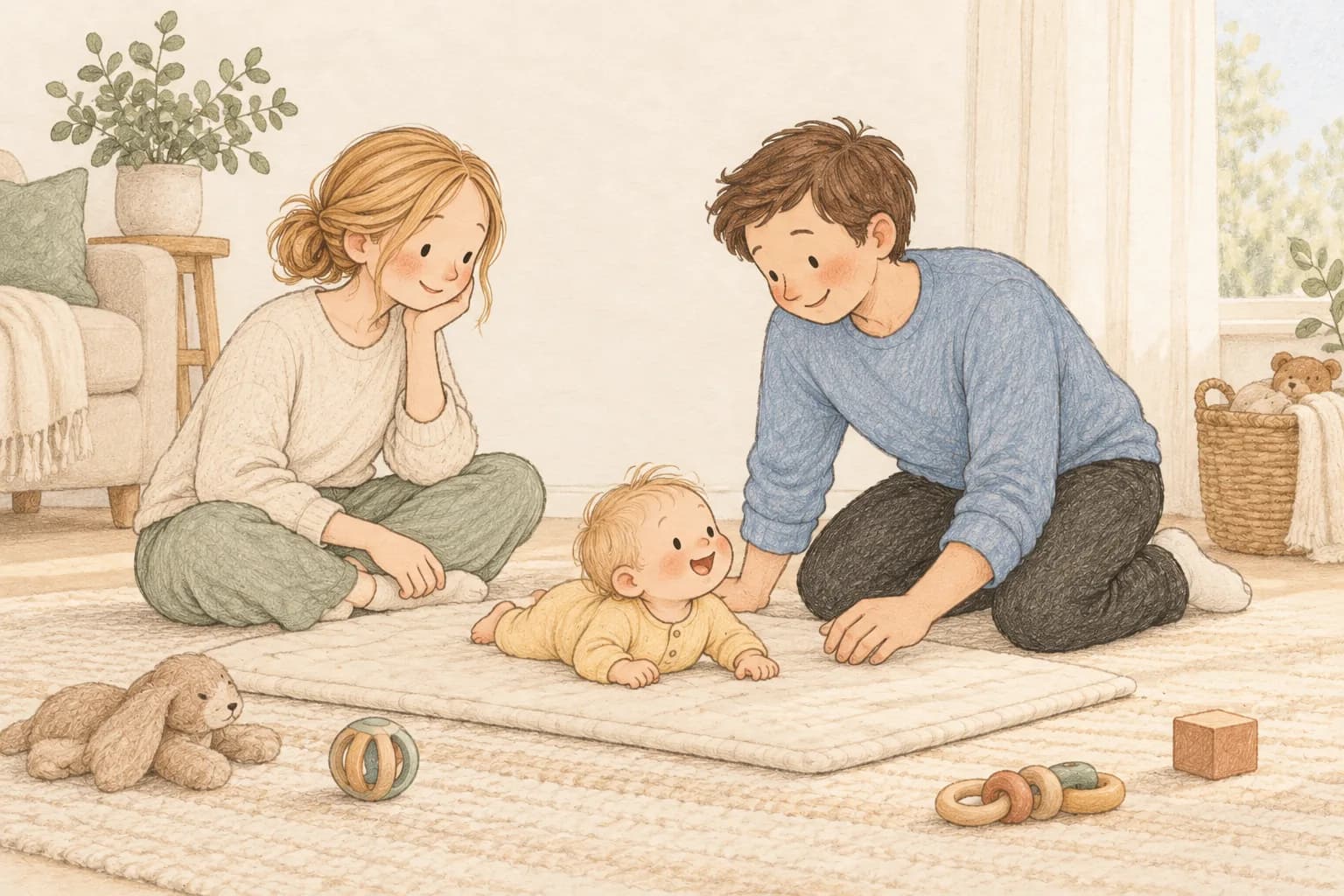
The cover illustration shows that distinction: an awake baby on the floor with an attentive parent nearby. It is not a picture of a recommended sleeping position.
You might notice a new movement during a short play period and simply note it for the next caregiver. Useful notes describe what happened, rather than grading the baby: “Rolled to tummy without help today; haven't seen the return yet.” There is no need to turn every play session into a milestone assessment.
A calm handover for grandparents or childcare
Try a short, shared explanation: “We start every sleep on the back, leave the crib clear, and have stopped the swaddle because rolling is beginning. Here is what we have actually seen them do.” Then check the sleep product used at that home or setting, too.
A caregiver may remember being given different advice years ago. You can acknowledge that without debating whose parenting was better. The practical aim is agreement about what happens today. Share the current public guidance and write down any individualized instructions from your baby's clinician.
If childcare has a written sleep policy, ask how it handles babies who start rolling and how staff record emerging skills. A consistent handover is more useful than sending several alarming social posts.
Common questions
What if my baby seems to sleep better on their tummy?
Longer or quieter sleep is not proof that a position is safer. Keep the recommended starting position and discuss persistent settling difficulty with your baby's healthcare professional. You can also review what to track about baby sleep so that the conversation includes what happens before and after waking.
Can a monitor make tummy sleeping safe?
No home monitor replaces the recommended sleep setup or prevents SIDS. NICHD advises against using heart, breathing, or motion monitors as a SIDS prevention strategy. A clinician-prescribed monitor for a particular medical condition is a separate matter; follow that care plan. NICHD: monitoring limitations
When should I get help rather than troubleshoot sleep?
Seek emergency medical help for difficulty breathing, blue or grey coloring, or a baby who cannot be woken. If something seems seriously wrong, act on it rather than waiting to collect tracking data. The NHS urgent-help guide describes warning signs; use your local emergency service.
For an otherwise well baby, uncertainty about rolling skills or repeated trouble settling is a reasonable thing to discuss with your pediatrician or health visitor. You do not have to solve it alone at midnight.
Sources checked September 28, 2026. General education from the Bambii Editorial Team; not individually reviewed by a clinician. Read our editorial standards or send a correction to team@bambii.app. Cover illustration generated with AI.