

Baby feeding · 7 min read
How Long Is Formula Good After Mixing? A Practical Storage Guide
Understand formula storage after mixing, the one-hour feeding limit, refrigerated bottles, and clear handoffs between caregivers.
Published by the Bambii Editorial Team
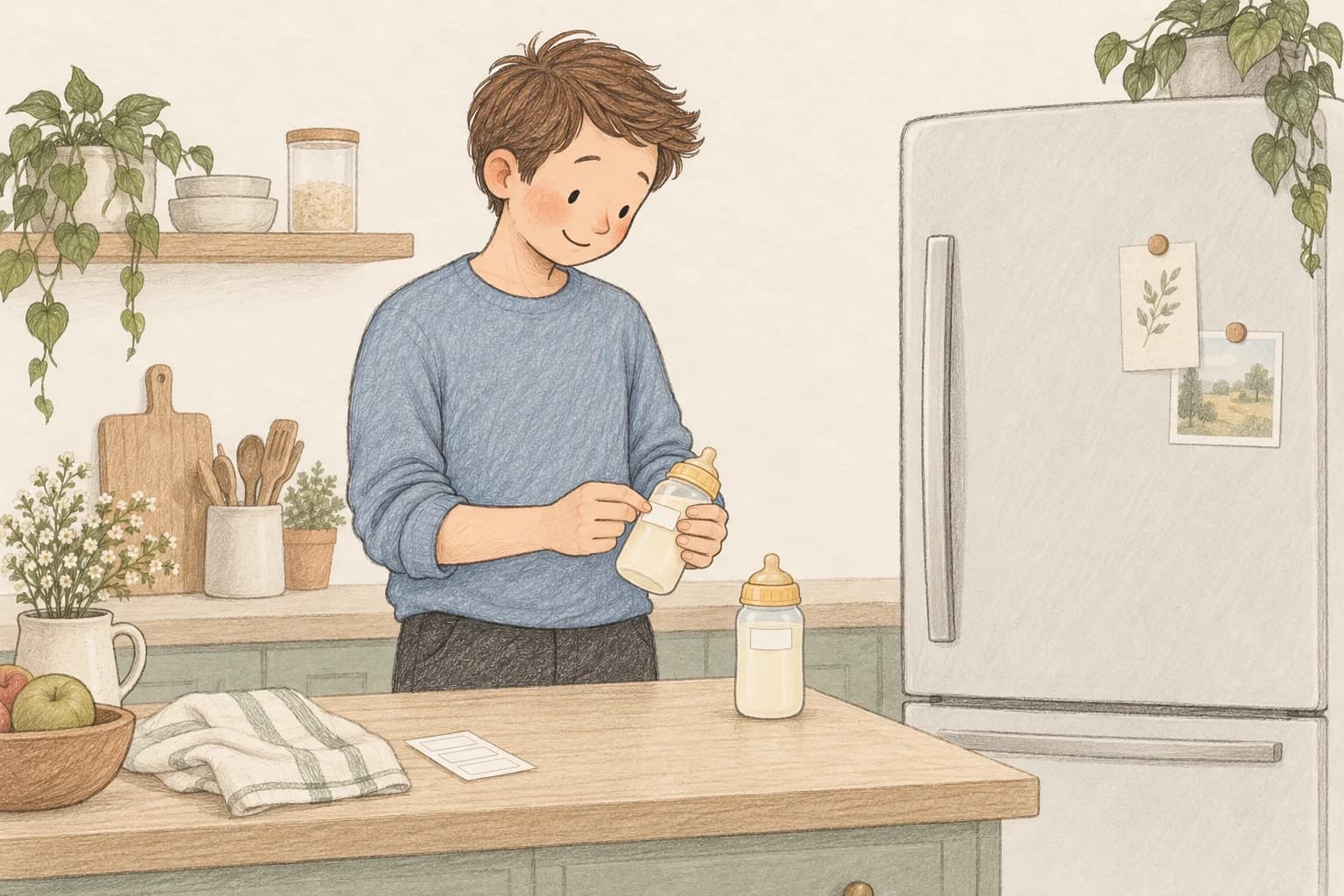
There is a bottle on the counter, a baby starting to fuss, and one question nobody can answer confidently: when was this formula made? It is a small detail that matters, especially when two caregivers are taking turns or the night has blurred into morning.
For prepared infant formula, the useful distinction is between a freshly mixed bottle, a bottle stored promptly in the refrigerator, and a bottle your baby has started drinking. They have different limits. This guide uses current U.S. CDC guidance for ordinary prepared formula. Always follow your product's label and any specific advice from your baby's care team; preparation guidance can differ by country and for specialist formulas.
How long is formula good for once mixed?
The CDC's formula preparation and storage guidance gives these limits:
| Situation | What to do |
|---|---|
| Freshly prepared formula kept at room temperature, before feeding | Use within 2 hours of preparation |
| Your baby starts drinking from that bottle | Use within 1 hour of the start of feeding, and within the original 2-hour room-temperature limit |
| Freshly prepared formula will not be used straight away | Refrigerate promptly and use within 24 hours of preparation |
| Formula remains after the feed | Discard the leftovers; do not save them for another feed |
For an unrefrigerated bottle, the earlier deadline applies. Beginning a feed does not restart the time since preparation. Refrigeration is a storage choice to make promptly, not a way to rescue a bottle that has already exceeded its safe limit.
A worked example
You mix a bottle at 2 p.m. and leave it at room temperature. If feeding begins at 2:15, the one-hour feeding limit is 3:15. If feeding begins at 3:30, the original two-hour limit arrives at 4 p.m., before the one-hour feeding window would finish. In either case, discard leftovers when the feed ends.
A separate bottle mixed at 2 p.m. and immediately refrigerated, untouched by your baby's mouth, has a refrigerated deadline of 2 p.m. the next day. Labeling the preparation time makes that much easier to remember.
Why a partly used bottle cannot go back into the rotation
Once your baby drinks, saliva enters the bottle. The CDC explains that the combination of saliva and formula allows bacteria to grow. Refrigerating the remainder does not make it a fresh, untouched bottle again.
That distinction is easy to lose during a handoff. “There is half a bottle left” describes the amount, but not whether it can be used. A clearer message is “That bottle was used for the last feed; please discard it.” Keep used bottles in a different place from prepared bottles waiting in the refrigerator.
It can feel frustrating to discard formula, particularly when it is expensive or your baby takes less than expected. The safer way to reduce waste is to prepare an appropriate amount using the exact label ratio, then make more if needed. Never stretch formula with extra water or change the scoop-to-water proportions.
Powder, concentrate, and ready-to-feed are different products
The FDA's safe-handling guidance distinguishes powdered formula, liquid concentrate, and ready-to-feed formula. Powder and concentrate need preparation according to their labels. Ready-to-feed formula does not need added water.
The storage instructions for an opened manufacturer container are not the same thing as the deadline for a bottle your baby has drunk from. Check the container's directions for refrigeration and disposal after opening. Do not assume every liquid product has the same opened-container limit.
Write the opening date on a powder container, keep it tightly closed in a cool, dry place, and use it within the label's timeframe. Do not refrigerate the powder itself. Its “use by” date and after-opening instructions both matter; use whichever limit comes first.
Extra care for more vulnerable babies
Powdered formula is not sterile. Babies born prematurely, very young infants, and babies with weakened immune systems may need additional preparation precautions or a different product choice. Discuss the safest plan with your clinician. This storage guide is not a substitute for those individualized preparation instructions.
Make the preparation and handoff easy to follow
You do not need an elaborate system. You need one system everyone uses the same way.
- Before making the bottle: clear the preparation area, wash your hands, and use clean feeding equipment. The CDC has a separate guide to cleaning and sanitizing feeding items.
- When the formula is made: record the preparation time. If it is going into the refrigerator, label the bottle before putting it away.
- When feeding begins: note the start time if there is a chance someone else will take over.
- When the feed ends: discard the remainder and put the bottle with the items waiting to be cleaned.
For example, a handoff note might say: “Two untouched bottles prepared at 8 p.m. are in the refrigerator; use by 8 p.m. tomorrow. The bottle on the draining board has already been used.” Clear names and times are more helpful than “fresh” or “from earlier.”
If you keep a feeding log in Bambii, use notes to support communication. The app does not test formula safety or know whether a bottle was stored correctly. A physical label is useful because it stays with the bottle.
Warming a bottle does not renew it
Formula does not have to be warmed. If you choose to warm it, follow safe warming instructions and avoid microwaves, which can create hot spots. The FDA's guidance for feeding babies safely also emphasizes following the manufacturer's directions for liquid products.
Use a warmed bottle promptly and follow the product's instructions. Do not repeatedly warm and cool the same bottle or assume warming starts a new storage period. When refrigeration has been interrupted or the history is unclear, do not guess from the bottle's temperature alone.
For outings, plan the storage and preparation method before leaving. A bag that feels cool is not proof that formula has stayed properly refrigerated. Your product's travel instructions and local public-health guidance should determine the plan.
Questions parents commonly ask
Can I smell it to decide whether it is safe?
Do not use smell or appearance to extend a stated storage limit. A label and a known preparation history are the basis for the decision. If you cannot establish when a bottle was made or whether feeding has started, discard it and prepare a fresh feed.
What if my baby falls asleep halfway through?
Stop feeding when your baby is finished and discard the remaining formula. Do not pressure them to finish to avoid waste. The CDC's hunger and fullness guidance explains why turning away or stopping sucking matters more than an empty bottle.
Does breast milk use the same storage rules?
No. Human milk has its own handling guidance. Do not apply a breast-milk storage chart to formula, or assume a bottle containing both can use the longer limit. Ask your care team about handling combined feeds if that is part of your baby's plan.
A small routine that removes a lot of guessing
The most useful habit is to label early, communicate clearly, and separate untouched bottles from used ones. That reduces the number of decisions an exhausted caregiver has to make in the middle of a feed.
For more help organizing care, read what to track for baby feeds and sharing a baby routine between caregivers. The aim is a clear record—not relying on somebody's memory at 3 a.m.
Sources checked September 24, 2026. Cover illustration generated with AI.