

Baby feeding · 8 min read
Can You Reheat Formula? What to Do With a Warmed Bottle
Learn when an untouched bottle can be warmed, why reheating never restarts formula storage time, and when a partly used bottle must be discarded.
Published by the Bambii Editorial Team
A bottle was warmed, the baby fell asleep, and now nobody is sure what happens next. The difficult part is that “reheat” can describe several different situations: an untouched refrigerated bottle, a bottle left at room temperature, or a bottle the baby has already drunk from. Those situations do not have the same answer.
The reliable rule is that warming does not create a new safety window. The original preparation time, storage history, and whether feeding has begun still decide what happens next. This guide follows current U.S. CDC guidance; also follow your formula label and local public-health advice, especially for babies who need additional preparation precautions.
The answer depends on which bottle you mean
| Situation | Practical answer | Why |
|---|---|---|
| Untouched formula was prepared, refrigerated promptly, and remains within its refrigerated limit | You can choose to warm it once using warm water and use it promptly, following the product label | It is still an untouched stored feed; warming does not extend its deadline |
| Formula has been sitting at room temperature | Use the original preparation deadline; warming does not restart it | Temperature changes do not erase elapsed storage time |
| Your baby has started drinking | Use within one hour of the start of feeding, then discard leftovers | Saliva enters the bottle and can support bacterial growth |
| You do not know when it was made, stored, warmed, or first used | Discard it and prepare a fresh feed | A bottle's warmth, smell, or appearance cannot reconstruct its history |
The CDC's current formula preparation and storage guidance does not give reheating a separate clock. It says prepared formula should be used within two hours of preparation and within one hour from when feeding begins. Untouched formula that will not be used within two hours should be refrigerated immediately and used within 24 hours.
That means “Can I reheat it?” is often the wrong first question. Ask: when was it prepared, was it refrigerated promptly, and has the baby drunk from it? If any answer is unknown, do not guess.
How to warm formula safely
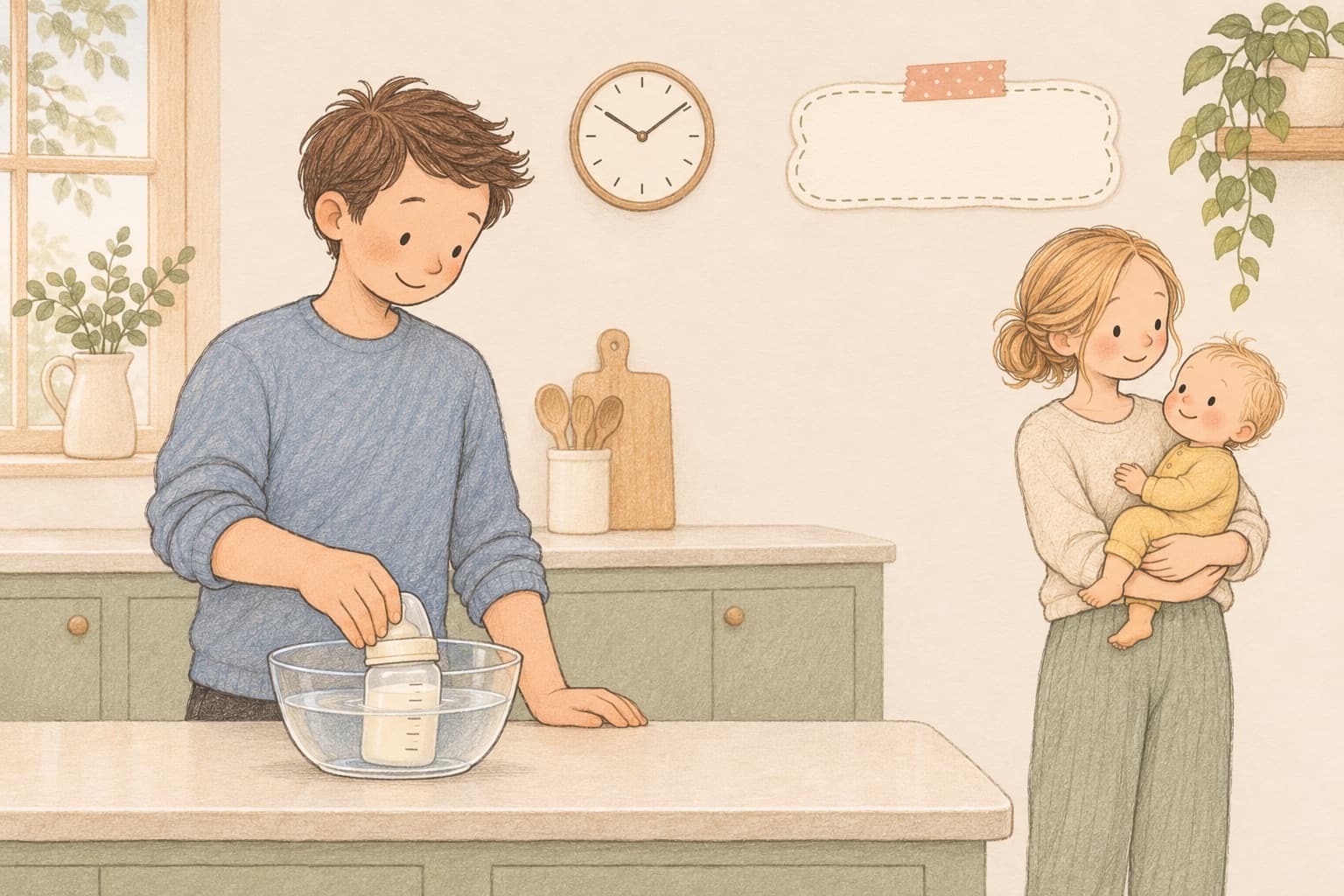
Formula does not have to be warmed. Room-temperature or cool formula is acceptable if your baby takes it and the product has been prepared and stored correctly. If you choose to warm a bottle, the CDC recommends placing it under running warm water while keeping water away from the nipple, or placing the closed bottle in a bowl of warm water for a few minutes.
- Check the bottle's history first. Confirm preparation time, storage, and whether feeding has started.
- Keep the bottle closed. Prevent warming water from entering the bottle or touching the nipple.
- Use warm, not boiling, water. The goal is gentle warming, not cooking the feed.
- Test before feeding. Put a few drops on the inside of your wrist; it should feel warm, not hot.
- Use the feed promptly. Keep following the original safe-use limit and the product label.
Never warm formula in a microwave
Microwaves can heat milk unevenly and create hot spots that burn a baby's mouth or throat. A bottle may feel comfortable on the outside while parts of the feed are much hotter. The CDC explicitly advises against microwave warming.
A bottle warmer is not a sterilizer and does not reset the storage period. Follow the warmer's instructions, keep it clean, and still check the bottle's preparation and feeding times.
The original time limits still apply
Here is the core timeline from the CDC for ordinary prepared infant formula:
- Before feeding at room temperature: use within two hours of preparation.
- After feeding begins: use within one hour from the start of feeding and within the original room-temperature limit.
- If it will not be used within two hours: refrigerate it immediately after preparation and use within 24 hours.
- After the feed: discard what remains in the bottle.
Use the earliest applicable deadline. If a bottle was prepared at 1 p.m. and feeding began at 2:30 p.m., the two-hour preparation limit arrives at 3 p.m., before the one-hour-from-feeding limit would end. Warming the bottle at 2:25 p.m. does not move either time.
Our formula storage guide explains those scenarios in more detail. If you are handling expressed milk, use separate human-milk storage guidance; do not transfer formula deadlines to breast milk or the other way around.
Partly used bottles should not return to the refrigerator
Once a baby drinks from a bottle, saliva mixes with the formula. The CDC advises discarding leftovers after feeding because that combination can allow bacteria to grow. Cooling the bottle again does not return it to an untouched state, and warming it later does not make it fresh.
It is understandable to want to avoid waste. A safer approach is to prepare an appropriate amount using the exact water-to-formula ratio on the label, offer more if needed, and follow your baby's fullness cues. Never dilute formula with extra water or change the scoop ratio to make it last longer.
Use a clear caregiver handoff
“There is a bottle in the kitchen” is not enough information. A useful handoff includes whether it is untouched, when it was prepared, when it entered the refrigerator, and whether feeding has begun.
For example: “The capped bottle on the left was prepared at 7 p.m. and put straight into the refrigerator. The bottle by the sink was used during the last feed and needs to be discarded.” A physical label stays with the bottle and is more reliable than expecting someone to remember which one was warmed.
If you record bottles in Bambii, use the log to support the handoff, not to certify safety. An app cannot know whether a bottle remained cold, whether water entered during warming, or whether somebody took a sip and forgot to record it. When the physical bottle and the record disagree, choose the cautious option.
Common questions
Can I warm untouched refrigerated formula more than once?
Do not use repeated warming and cooling as a storage method. The CDC does not provide a new safe-use period for each warming. Plan to warm the amount you expect to use, use it promptly, and follow the label. If the product's instructions are more restrictive, follow them.
How long is formula good after warming?
Warming does not replace the original limits. Track time from preparation and from the start of feeding, then use the earlier applicable deadline. If the bottle was refrigerated, follow the product label and use it promptly after warming rather than returning it to a warm-cool cycle.
Can I reheat formula my baby did not finish?
No. Once feeding has begun, use the bottle within one hour and discard the remainder. Do not refrigerate and reheat those leftovers for another feed.
Can I tell whether formula is safe by smelling it?
No. Smell and appearance do not extend a stated time limit or replace a known storage history. If you cannot establish when the bottle was made or whether feeding began, discard it.
Do the same rules apply to every baby?
Some babies need additional precautions. Powdered formula is not sterile, and current CDC guidance includes extra preparation steps for babies younger than two months, babies born prematurely, and babies with weakened immune systems. Follow individualized instructions from your clinician and the formula manufacturer.
CDC guidance checked November 2, 2026. This is general education, not individual medical advice, and it was not individually reviewed by a clinician. Always follow the formula label and your baby's care plan. Read our editorial standards or send a correction to team@bambii.app. Cover illustration generated with AI.