


Baby development · 8 min read
When Do Babies Start Walking? First Steps, Safe Practice, and When to Ask
Understand cruising and first steps, CDC walking milestones, safe practice without seated walkers, and when to seek developmental advice.
Published by the Bambii Editorial Team
Babies do not all start walking at the same age. For useful check-in points, the CDC lists pulling up and walking while holding furniture by 12 months, a few independent steps by 15 months, and walking without holding on by 18 months. These are developmental milestones, not a race or a diagnosis. If a milestone is missing, a skill is lost, or something concerns you, talk with your child's healthcare professional rather than waiting for a later deadline.
It is easy to hear “she is walking” and picture a toddler confidently crossing the room. Another parent may mean two steps between adults, or sideways movement along a sofa. Those are different observations, and knowing the difference makes comparisons less confusing.
This guide helps you notice the stage your child is in, make room for safe practice, and bring useful questions to a developmental check.
What counts as walking?
Pulling up means using support to move into standing. Cruising means moving along while holding something stable, such as secured furniture. Independent steps happen without a hand or piece of furniture providing support.
A baby may use several ways of getting around during the same afternoon. Taking a first step does not mean crawling disappears immediately or that walking is suddenly the easiest choice. Describe what you see rather than choosing a label that sounds more advanced.
For example, “He pulls up at the sofa and moves sideways while holding it” gives a clearer picture than “nearly walking.” You can enjoy that stage without needing to turn the next family visit into a demonstration.
Our guide to crawling covers earlier floor movement. This guide focuses on standing, cruising, and first steps, rather than requiring every baby to follow an identical route between them.
Use milestones as check-in points
The CDC describes milestones as skills that at least 75% of children can do by the stated age. The lists are not a substitute for a validated developmental screening.
| Age | Walking-related CDC milestone | What to mention at a check-in |
|---|---|---|
| 12 months | Pulls up to stand; walks holding on to furniture | Whether your baby gets into standing and moves with support. |
| 15 months | Takes a few steps independently | Whether any steps happen without holding a person or object. |
| 18 months | Walks without holding on | How your child moves around in ordinary play. |
Read the full checklists for 1 year, 15 months, and 18 months. If a milestone is missing, the CDC recommends acting early and asking about developmental screening.
This means “not walking at the first birthday” and “no need to discuss anything until 18 months” are not equivalent conclusions. Look at the relevant skills and the whole developmental picture with a professional. You can ask a question even when you are unsure whether there is a delay.
For a child born prematurely or with an existing condition, ask their care team how to interpret these ages and what their individual plan should be. Do not adjust a therapy programme using a general article.
Make the room ready before encouraging more movement
The NHS children's health guide to learning to walk emphasizes a firm floor or carpet, secure furniture, and a babyproofed space. A bed or pile of cushions is not a suitable walking practice surface.
Look around from your child's new reach. A table that was out of reach during crawling may now hold something they can pull down. Secure furniture, remove accessible hazards, protect stairs appropriately, and keep an adult close.
Choose one manageable patch of floor rather than setting up an obstacle course. Move loose bags, cords, and toys out of the route. Let other adults know that this is the child's play space so it does not become the landing zone for a hot drink or shopping bag.
You do not need to make the whole room look like a nursery photograph. The useful question is whether your baby has a stable, supervised place to explore without being drawn towards something unsafe.
Offer opportunities without turning them into drills
Start with the movement your baby is choosing. If they pull up at a stable sofa, stay nearby and place an interesting toy within a comfortable reach along it. If they are already taking steps, sitting a short distance away can offer a welcoming destination.
Keep the invitation easy to abandon. If your child sits down, crawls instead, or wants to stop, let that be the next part of play. Avoid repeatedly moving the goal farther away just as they reach it.
The NHS guide describes encouraging cruising and gradually exploring nearby stable supports. It also notes that barefoot practice at home may help balance. Use a clean, safe surface with a suitable temperature, and follow any individual footwear advice from your child's clinician.
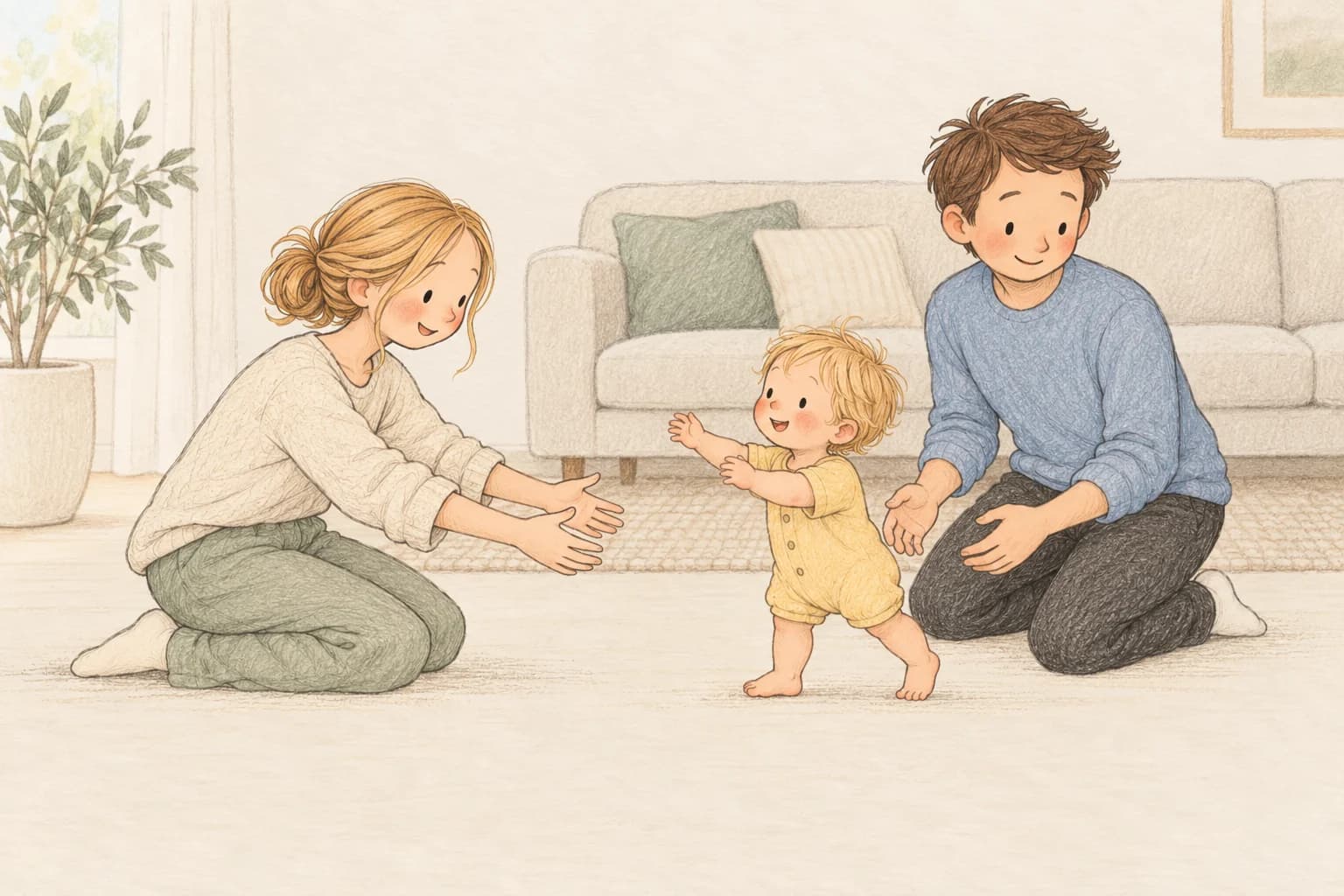
An example family moment might be one parent sitting on the floor near the sofa while the other stays close to the child. They smile at a step, then carry on with the game. There is no required number of crossings or reason to repeat the attempt until someone gets upset.
Skip seated wheeled baby walkers
The American Academy of Pediatrics advises against baby walkers with wheels. They can cause serious injuries, do not teach babies to walk, and may delay walking. Close supervision does not remove their hazards.
Here, “walker” means the equipment a baby sits inside and moves around on wheels. A product's name, an older relative's experience, or a claim that it keeps a baby busy is not evidence that it is a safe shortcut to first steps.
Push-along toys are a different category, but they are not essential either. Do not feel you need one to complete a developmental stage. The floor-based activities in this guide do not require buying equipment.
If you have been given a seated wheeled walker, tell every caregiver that you are not using it. A clear handover avoids a well-meaning adult bringing it out because the baby seemed interested in standing.
Keep shoes and equipment in perspective
Learning to walk does not automatically create a shopping list. Consider what needs protecting in the actual setting rather than choosing shoes because they promise earlier steps.
At home, barefoot time on an appropriate surface may be practical. Outside, your child needs protection suited to the environment. If you have questions about footwear, unusual foot position, or a prescribed support, ask an appropriate healthcare professional. Do not replace prescribed equipment with advice from a shoe advertisement or a general guide.
A useful approach is to separate two decisions: “What keeps these feet protected here?” and “Is there a developmental concern that needs assessment?” Buying a different product does not answer the second question.
Notice progress without constantly testing it
You can keep a short note of what happens naturally: pulling up, moving along furniture, taking a step, or walking between familiar places. A brief description is usually easier to share than a collection of competing age comparisons.
For a healthcare appointment, write down what you have noticed and when. If you already have a short video of ordinary movement, ask whether it would help the clinician. You do not need to stage repeated attempts to capture a perfect performance.
New movement skills can also change what your child chooses to practise during the day. Offer safe opportunities while awake, but do not assume every difficult night is caused by walking. Illness, feeding, comfort, and other circumstances still deserve attention.
The Bambii Sleep Academy discusses routines around developmental change. It cannot assess gait or diagnose a delay. For questions about a changing night pattern, our sleep-routine guide can help organize observations separately from the walking question.
When to get help
Contact your child's healthcare professional when a listed milestone is missing, a previously acquired skill is lost, or you have another concern about development. Ask what assessment or screening is appropriate. Do not wait for an article's upper age marker if you are already worried.
Useful questions include: “Which movements would you expect at this stage?”, “Does the way my child moves need assessment?”, and “What should we look for before the next appointment?” If a follow-up is recommended, clarify when and whom to contact if something changes sooner.
Home activities can accompany appropriate care, but they should not delay it. A parent does not need to exhaust a list of exercises to earn a developmental assessment.
Common questions
My 12-month-old cruises but does not walk alone. What does that mean?
Cruising is included in the CDC's 12-month checklist; independent steps appear in the 15-month list. Discuss your child's overall development and any concerns at their check-in rather than judging them by another baby's first birthday video.
Is a first step the same as confident walking?
No. Describe the actual movement: a few unsupported steps and moving independently around a room are different stages. Both are worth noticing without exaggerating either.
Will more practice make my baby walk sooner?
This guide cannot promise that. Offer safe, enjoyable opportunities and follow your child's interest. If you are concerned about progress, seek individual advice rather than increasing pressure or buying a device.
Sources checked October 8, 2026. General education from the Bambii Editorial Team; not individually reviewed by a clinician. Read our editorial standards or send a correction to team@bambii.app. Cover illustration generated with AI.