


Baby development · 9 min read
What to Do With a 2-Month-Old When Awake: Simple, Calm Activities
Practical activities for a two-month-old's awake time, including face-to-face play, tummy time, cues, feeding, and flexible wake-window context.
Published by the Bambii Editorial Team
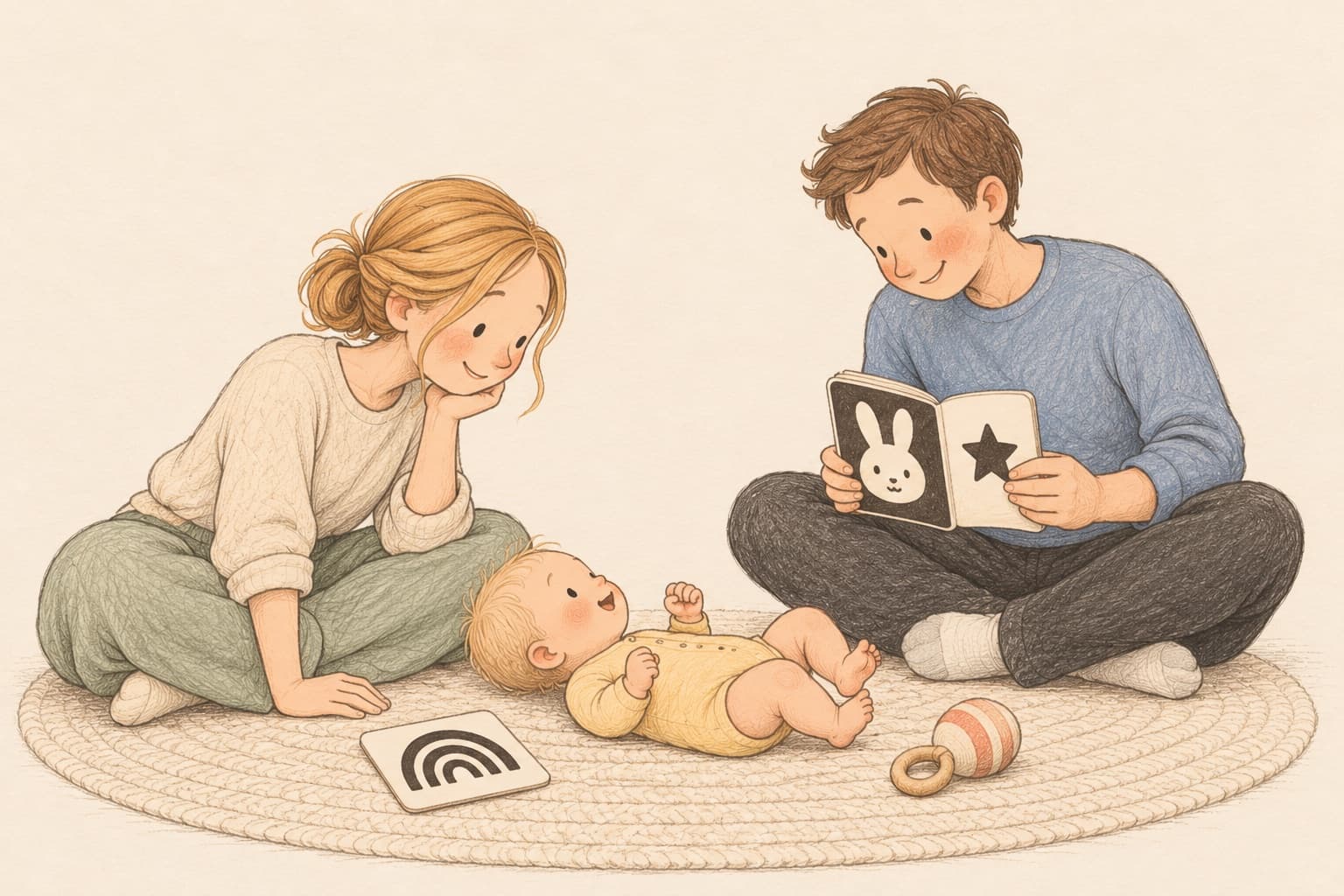
A two-month-old can suddenly feel much more awake than the newborn you brought home. They may watch your face, make a small sound, or look around as if they are waiting for something to happen. That does not mean you need a full activity schedule. At this age, a feed, a cuddle, a conversation, and a few minutes on the floor can be a full awake period.
This guide is for ordinary, healthy awake moments. It is not a developmental test or a reason to keep a tired baby awake. If your baby was born prematurely, has a feeding or medical plan, or you are concerned about how alert they seem, use the guidance from their healthcare team.
Begin with what your baby needs
Before choosing an activity, check the basics. Your baby may need milk, a nappy change, help with a burp, closeness, a calmer room, or another sleep. Care is not the interruption before the useful part of the awake period. It is the useful part.
The CDC's two-month milestone guidance describes common hunger cues such as hands moving toward the mouth, turning toward a breast or bottle, and lip movements. It also describes fullness cues such as closing the mouth or turning away. Responding to those signals matters more than completing a planned activity.
Once your baby is comfortable, notice whether they seem available for interaction. A calm face, looking toward you, or making small sounds may be an invitation. Looking away, fussing, yawning, or becoming disorganized can be a request for less. None of these signs has only one meaning, so check the whole situation.
Seven simple activities for a two-month-old
1. Talk face-to-face
Hold your baby securely with their head and neck supported, or sit close while they lie in a safe awake-play space. Talk about what is already happening: “Here is your sleeve,” or “I can see you looking at the window.” Pause occasionally and let your baby look or respond in their own way.
The CDC lists looking at faces, smiling in response, and making sounds other than crying among milestones many babies show by two months. Milestones describe what most children can do by an age; they are not a performance checklist for one play session.
2. Copy their sounds
If your baby coos or makes a soft sound, copy it once and wait. This can create a tiny back-and-forth exchange. If they do not answer, nothing has gone wrong. You can smile, say something gentle, and move on.
3. Look at one high-contrast picture
Hold a simple black-and-white card or board-book picture where your baby can comfortably see it. Move it slowly only if they seem interested. A picture is enough; you do not need flashing lights or a constantly changing display.
The American Academy of Pediatrics' developmental guide includes high-contrast images, sturdy rattles, singing, and soft music among age-appropriate options around two months.
4. Sing a familiar song
Sing a verse you know or make up a simple tune during a change. The value is the familiar voice and shared moment, not the quality of the performance. A partner or other caregiver can have their own song, giving the baby another predictable way to connect.
5. Read one page
Choose a board book, show one picture, and name what you see. Finishing the story is optional. If your baby loses interest after a few seconds, close it. Reading to a two-month-old can be wonderfully brief.
6. Offer brief, supervised tummy time
Tummy time is for an awake baby with an adult watching closely. The AAP recommends short tummy-time sessions and distinguishes them clearly from sleep: back for sleep, tummy for supervised play.
You might begin on your chest while you are fully awake, across your lap, or on a clear floor mat. Keep your baby's face unobstructed and stay beside them. If they become sleepy, move them to their safe sleep space on their back. Our guide to starting tummy time has more setup ideas.
7. Let them quietly look around
Not every awake minute needs an object or instruction. Sit nearby while your baby looks at your face, the light on a wall, or the room. Quiet observation is still an experience. It can also give you a clearer view of when your baby wants more interaction and when they want less.
How long should a two-month-old be awake?
There is no clinical wake-window target that every two-month-old must meet. Bambii's Sleep Academy uses a broad newborn planning range of roughly 45–90 minutes and emphasizes that feeding counts as awake time. Other published parenting guides use overlapping but not identical ranges. Treat those numbers as context, not a minimum or deadline.
A feed and nappy change may use most of an awake period. On another day, your baby may have a calm stretch for talking and floor play. Individual variation is expected, and the same baby can cope differently after a short nap, an unsettled feed, travel, illness, or a busy day.
If you want to understand timing, record when sleep actually starts and ends, then compare similar days. Do not keep a sleepy baby awake to reach a chart. Our newborn wake-window guide explains this in more detail, and the flexible wake-window decision guide separates planning ranges from medical guidance.
What can a realistic awake period look like?
A longer alert moment: Your baby wakes, feeds, has a nappy change, and looks calmly at you. You talk for a few minutes, try a short tummy-time session, then reduce stimulation when they look away and begin a wind-down.
A care-only moment: Your baby wakes hungry, feeds slowly, needs a change, and becomes sleepy in your arms. There is no separate play session. You spoke and made eye contact during care, then helped them return to sleep.
A handover moment: One caregiver finishes a feed and tells the next person, “They have fed and been changed. They were looking at faces, but they are starting to turn away.” That short description is more useful than an activity list someone must finish.
If your family uses Bambii, you can keep sleep and feeds in one timeline and add context when it is genuinely useful. You do not need to log every song, smile, or minute of play. The goal is to reduce mental load, not turn connection into data entry.
Questions parents ask
Should I entertain my two-month-old throughout every wake window?
No. Feeding, changing, holding, talking, and quiet observation can fill much of the time. One short activity is enough when your baby is interested.
What if my baby dislikes tummy time?
Try a shorter session or a different supervised position, such as across your lap or on your chest while you are fully awake. Stop if your baby is distressed and try again later. Ask your baby's clinician for individualized guidance if positioning is difficult or you have concerns about movement or development.
Does a two-month-old need educational videos?
No. The CDC recommends limiting screen use under age two to video calls with loved ones. A baby this age learns through responsive interaction, movement, looking, listening, and everyday care.
When should I ask for help?
Talk with your baby's clinician if they have lost a skill, you are concerned about feeding or development, or their alertness seems different from usual. Seek urgent medical help for breathing difficulty, blue or grey skin or lips, or a baby who cannot be woken. A temperature of 38°C or higher in a baby under three months needs prompt medical assessment.
Sources checked November 2, 2026. General education from the Bambii Editorial Team; not individually reviewed by a clinician. Bambii Sleep Academy was used for Bambii's broad planning range and its emphasis on individual variation. Read our editorial standards or send a correction to team@bambii.app. Cover illustration generated with AI.