


Baby sleep · 10 min read
How to read and adjust newborn wake windows without causing overtiredness
Read newborn wake windows, recognize sleepy cues, and explore feeding rhythms, sample days, and adjustments for short naps.
Published by the Bambii Editorial Team
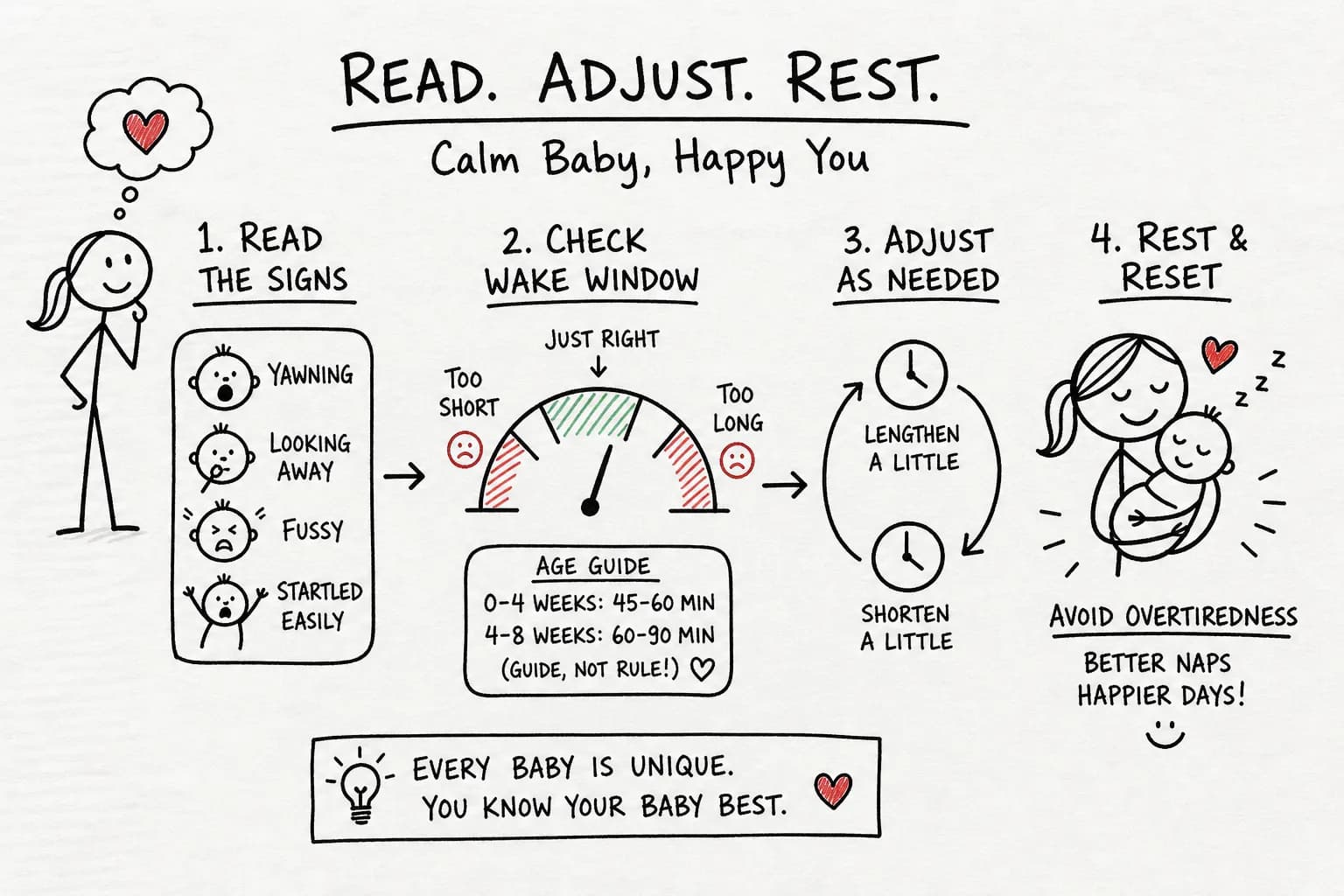
Picture this: your baby just finished a feed, her eyes are getting glassy, and you're standing there trying to decide if you have 10 more minutes of awake time or if you already missed the moment. Understanding newborn wake windows, the short periods a baby can comfortably stay awake between sleep periods, makes it easier to time naps and avoid the overtiredness that turns an easy settle into a 45-minute battle. Getting these windows right has a genuine ripple effect on how long naps last, how settled nights become, and how much fussing fills the hours in between.
The good news is that these windows follow a predictable developmental arc. They're not random. Once you know the age-appropriate ranges and learn to read the signals your baby sends before the window closes, the day starts to feel a lot less like guesswork. Bambii, the iOS app built for exactly this stage, tracks your baby's feeds and sleep history to predict the next nap window in real time, so you're not mentally calculating on four hours of sleep. By the end of this article, you'll know the age-by-age awake-time ranges, how to catch sleepy cues before they escalate, what realistic daily rhythms look like at two, four, and eight weeks, and what to do when naps keep cutting short.
Newborn wake windows by age: what the numbers actually tell you
Pediatric sleep guidance consistently clusters around three age bands in the first three months. For newborns aged zero to four weeks, the recommended awake time between sleep periods is roughly 30 to 60 minutes. From four to eight weeks, that window stretches to about 45 to 60 minutes. By eight to twelve weeks, most babies can handle somewhere between 60 and 90 minutes before sleep pressure builds to a point where settling becomes difficult.
Infant wake window chart: a quick reference
| Age | Wake Window | Typical Naps Per Day |
|---|---|---|
| 0, 4 weeks | 30, 60 minutes | 6, 8 |
| 4, 8 weeks | 45, 60 minutes | 5, 6 |
| 8, 12 weeks | 60, 90 minutes | 4, 5 |
Why so short? A newborn's nervous system hasn't matured enough to handle extended stimulation without consequence. They burn through sleep pressure quickly, and when they stay awake beyond their capacity, stress hormones can rise with prolonged wakefulness, which may make settling harder than it would be with better-timed sleep. These ranges exist to help parents stay ahead of that curve, not to impose a rigid schedule.
Your baby's actual window may sit anywhere within that range, and the range itself is a starting point, not a stopwatch. A 10-week-old who had a calm morning and a full feed may comfortably handle 80 minutes. The same baby after a fussy, stimulating nurse might need sleep at 55 minutes. The goal is to use the age range to set your starting expectation, then refine it by watching what your baby actually does. Logging what happens after each nap, including how awake time compared to how well the baby settled, is what turns the general range into something specific to your child.
How to read sleepy cues before the newborn wake window closes
Most parents miss the window not because they don't know the time ranges but because they're watching for the wrong signals. The cues that get the most attention, yawning, eye rubbing, and grizzling, are actually late signs. By the time those appear, the ideal sleep window has often already passed, and you're working against a baby who is already uncomfortable from overtiredness.
The early cues are quieter and easier to miss. Watch for a blank or glazed stare, reduced movement, a shift away from eye contact, and a loss of interest in faces or what's happening around them. These are the signals that say the window is open and the timing is right. Quiet disengagement is often a reliable sign of tiredness. Escalating distress with no obvious cause usually points to overstimulation. Knowing which one you're dealing with matters because the responses differ.
An overtired newborn typically moves from withdrawal into frantic, difficult-to-console crying. An overstimulated baby shows back-arching, stiffening, and frantic movement even when awake time has been short. An overtired baby needs to get to sleep immediately. An overstimulated baby needs a calm, low-stimulus environment first, and then sleep. Once you can tell them apart, you'll know exactly what step to take next rather than guessing while a baby cries harder.
How feeding timing shapes your newborn nap schedule
For the first eight to twelve weeks, feeding type and feeding timing are inseparable from how nap windows land. Breastfed newborns typically need to eat every one and a half to three hours because breast milk digests faster, which naturally produces more frequent napping cycles across the day. Formula-fed babies tend to go three to four hours between feeds and may tolerate slightly longer awake stretches between naps. Neither method reliably produces longer overnight stretches in the early weeks; formula isn't a shortcut to extended sleep, it just shifts the rhythm slightly.
The most practical framing for a newborn's day is a repeating loop: feed, brief awake time with cue-watching, then nap. After a feed, shift your attention to your baby rather than the clock. Watch for the early cues described above and move toward sleep when they appear, rather than waiting for a specific number of minutes to pass. Keeping an accurate feed log, including the time, duration, and whether the baby seemed satisfied, gives you a reference point for when the next nap window is likely to open. This is exactly where Bambii's feed tracking and real-time caregiver sync become useful: when a partner or grandparent handles a feed, the logged data updates across all devices so everyone is working from the same baseline, not from a rushed text message.
Sample 24-hour rhythms for 2, 4, and 8-week-olds
A 2-week-old's day is best understood as a series of small loops rather than a schedule with named blocks. A realistic example: feed around 7:00 AM, brief awake time, then down for a nap from about 7:45 to 9:15 AM. That cycle repeats through the day, with overnight feeds around 11:15 PM, 1:15 AM, 3:15 AM, and 5:15 AM being completely normal and developmentally appropriate for this age. The goal at this stage isn't stretching anything, it's building a consistent, predictable rhythm that the baby can start to recognize.
At four weeks, awake windows stretch slightly. A sample day might include a 7:00 AM feed, a nap from 8:00 to 9:30 AM, and five to six naps spread across the day with two to three overnight feeds. By eight weeks, awake windows are edging toward 75 to 90 minutes. The day typically includes four to five naps, and some babies begin consolidating one slightly longer stretch overnight, though this varies widely. These examples can shift by 30 minutes or more depending on the individual baby, which is exactly why tracking real sleep and awake times reveals patterns that any generic chart cannot.
Treat these sample rhythms as a starting template to test, not a timetable to protect. If your baby consistently settles easily and naps well at slightly different times than the sample, trust what your baby is showing you. Your baby's behavior is always more reliable data than any printed schedule.
What to do when naps are short or nights keep breaking up
Short naps in the newborn stage almost always trace back to one of four causes: the awake window was slightly off in one direction or the other, the sleep environment has too much light or sound, the baby is waking at the natural end of a sleep cycle around the 45-minute mark, or the baby relies on nursing or motion to fall back asleep and can't connect cycles independently. Identifying the right cause before making changes saves a significant amount of frustration and wasted days.
The most effective troubleshooting approach is sequential and patient. Start with the awake window. Shift it earlier or later by 10 to 15 minutes and run that experiment for three to four days before drawing any conclusions. Then look at the sleep environment: a dark room and consistent white noise are two commonly recommended changes that can improve nap length without requiring any other adjustment. If a baby wakes mid-nap, pause briefly before going in, some babies resettle within a few minutes on their own. If multiple short naps stack up across a day, move bedtime earlier rather than trying to extend the next wake window further. The core rule is to change one variable at a time so you can actually know what moved the needle.
A quick note on short-nap recovery
One thing to avoid after a short nap: shortening the next wake window to compensate. That often produces another short nap. Keep the next awake period age-appropriate and, if needed, use an earlier bedtime to make up for the lost daytime sleep. Think of it as borrowing from bedtime rather than from the next nap.
How tracking newborn wake windows turns theory into a working routine
A wake window chart gives every parent the same starting point. What makes it personal is consistent logging of what actually happens with your specific baby over time. Even a 10 to 15-minute difference in timing can be the gap between a 30-minute nap and a full sleep cycle. The only way to find your baby's personal sweet spot is to track awake times and nap outcomes consistently enough to see a pattern forming across multiple days.
Without that data, parents end up re-reading the same general charts and getting the same general answer. With it, you start to see things like "when awake time hits 75 minutes, naps run long" or "after a fussy feed, she needs sleep 10 minutes sooner." Those specific observations are what actually improve nap consistency, and they're impossible to notice without a log.
Bambii's prediction engine uses your baby's actual logged sleep and feed history to forecast the next nap window, and the prediction updates as patterns shift week by week. The lock-screen widget shows that predicted nap time at a glance so you don't need to open an app mid-feed.
Real-time sync keeps partners and caregivers working from the same data, which eliminates the contradictory routines that happen when one person doesn't know about the last nap. The 14-day Baby Sleep Academy course inside Bambii also draws from your tracked data to give tailored, gentle guidance rather than the same generic advice that applies to every baby except yours. For a parent actively experimenting with newborn wake windows, having all of this in one place makes each adjustment easier to test and measure.
Putting it all together
Newborn wake windows aren't rigid rules, they're a starting range you tune by watching real cues and logging real outcomes. The 30 to 90-minute arc across the first 12 weeks gives you the framework, early sleepy cues tell you when to move, and the feed-wake-sleep rhythm keeps everything connected day to day. When naps go short, change one thing at a time and give it a few days before drawing conclusions.
Tracking is what turns all of this from general advice into a working routine specific to your baby. Every log entry sharpens the picture of your baby's personal pattern, and over a few days those patterns become genuinely useful. If you're ready to stop guessing and start building a rhythm that holds, Bambii's 7-day free trial is a practical place to start. Track a few days of real feeds and sleep, and watch the guesswork begin to shrink.