


Baby development · 9 min read
Fine Motor Activities for Infants: Simple Play for Growing Hand Skills
Explore safe infant hand-skill activities, first-year CDC milestones, age-appropriate toys, and when to ask for developmental support.
Published by the Bambii Editorial Team
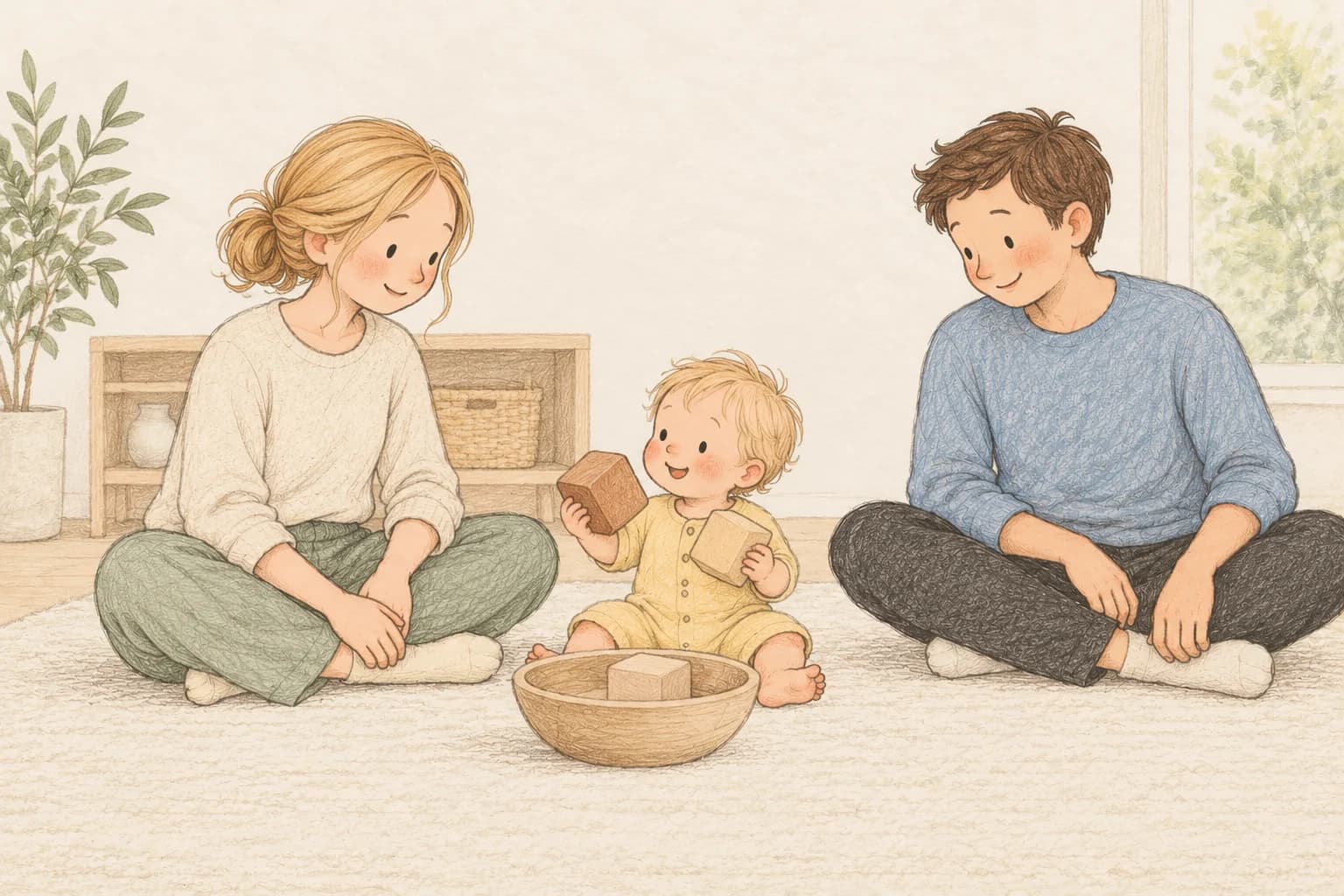
The most useful fine motor activities for infants are simple opportunities to reach, hold, transfer, and release safe objects while an adult stays close. Choose an activity your baby can explore now, allow plenty of pauses, and stop when they need something else. You do not need tiny craft materials, special lessons, or a daily performance target.
Fine motor skills involve smaller movements, including the hands and fingers. You might notice your baby studying their hands, reaching towards a toy, or working out how to let go of something inside a container. These ordinary moments give you plenty to play with.
This guide focuses on hand play during the first year. The age markers below help you notice development and discuss concerns; they are not deadlines for mastering a set of games.
Start with what your baby is doing today
Look before adding another toy. Does your baby watch their hands? Hold something you offer? Reach for a nearby object? Move it between hands? Begin there.
If your baby is exploring a large ring with their whole hand, that is enough for today's activity. There is no need to guide each finger into a more advanced grip. If they would rather look at your face or have a cuddle, the play idea can wait.
Choose a comfortable, awake moment. Keep the baby supported in a position suited to their abilities, on a safe floor-level play area rather than a bed or changing table. A baby who cannot sit independently needs appropriate support; do not prop them between cushions and step away.
Our guide to babies learning to sit covers that separate movement skill. Hand play should fit your baby's current position, rather than making an unsupported position the price of joining in.
A first-year map of hand skills
The CDC lists milestones that at least 75% of children can do by a given age. These checklists help families notice skills; they do not replace a standardized developmental screening or an individual assessment.
| CDC check-in age | Examples of hand-related skills | An invitation to try together |
|---|---|---|
| 4 months | Holds a toy placed in the hand; swings an arm towards toys; brings hands to the mouth | Offer one suitable easy-grip toy and pause. |
| 6 months | Reaches to grab a wanted toy; explores with the mouth | Place a safe toy nearby and let your baby reach. |
| 9 months | Transfers an object between hands; bangs two objects together | Offer two large baby-safe blocks while sitting safely. |
| 12 months | Puts an object into a container; picks up food between thumb and finger | Explore a large block and a wide, shallow container. |
See the original CDC checklists for 4 months, 6 months, 9 months, and 1 year. The play suggestions in the final column are ways to offer an opportunity, not tests or treatments.
One child may first show a skill while playing with a familiar toy; another may demonstrate it during a meal. A missed moment in your observation is different from knowing that a skill is absent. If you are unsure, describe what you have seen to your child's healthcare professional.
Five simple activities to adapt
1. Offer one object and wait
Choose an intact toy designed for your baby's age, such as a large easy-grip rattle or ring without detachable pieces. Let your baby notice it. Offer it gently rather than repeatedly pushing it into their hand.
Watch what happens next. Looking, touching, holding briefly, or bringing the toy towards the mouth can all be part of the interaction. You can name what you see: “You've got the ring.” There is no need to turn every attempt into a correction.
If the toy drops, return it within comfortable reach. Avoid making the task progressively harder just because one attempt worked.
2. Make a small reaching invitation
When your baby is beginning to reach, put a suitable toy nearby on the floor during supervised play. Give them room and time to move towards it in their own way. The NHS play guide includes placing toys near babies so they can reach for them.
Try one object rather than surrounding the baby with choices. If reaching turns into frustration, bring the toy closer or offer it. The purpose is shared exploration, not making your baby work harder for access to play.
An example might be a few reaches after a nappy change, followed by a cuddle. That is a complete activity; it does not need a longer session to count.
3. Explore two large objects
For a baby already sitting safely and holding toys, offer two age-appropriate blocks large enough not to be choking hazards. Let them touch, transfer, or tap them together.
You might tap your own pair once and wait for a response. If the baby drops one and keeps the other, follow that interest. Do not take over their hands to produce the movement you hoped to see.
Keep the sound comfortable. This is not a competition to make the loudest crash, and hard objects should stay away from faces. Remove the activity if it becomes unsafe or the baby is no longer interested.
4. Put something in, then take it out
Near the end of the first year, a large block and a broad, shallow, unbreakable container can offer a satisfying game. Show one slow “in,” then leave space for your baby to try whatever interests them.
They may prefer taking the block out, turning the container over, or handing it to you. Those are useful clues about what they enjoy; you do not need to insist on a tidy finished result.
Avoid containers with tight lids, pinch points, sharp edges, or parts that break away. Keep the game dry and simple. Water, rice, beads, and other sensory-bin ingredients are not necessary for this activity.
5. Share a sturdy baby book
Sit together and offer an intact book made for babies. Let your baby touch a picture or explore a sturdy page with your help. The NHS recommends sharing books from an early age; a baby does not need to follow a whole story for the time together to be worthwhile.
You can talk about one picture and stop. If the book is being mouthed, check it for damage and follow its care instructions. Remove loose or torn pieces. A quiet page together is enough; there is no requirement to finish the book.
Keep small objects out of the activity
Learning a more precise grip does not make tiny materials safe. Follow toy age warnings and check for small or broken parts, as the NHS play guidance advises. Do not use coins, beads, buttons, dried beans, or pom-poms as infant hand-skill activities. Supervision does not turn a choking hazard into an appropriate toy.
Keep older siblings' small construction pieces in a separate play area. A useful household habit is to check the floor before putting the baby down, particularly after visitors or an older child's game.
Food is a separate decision. Do not introduce small foods just to practise a pincer grip. Feeding needs to match your baby's readiness, texture skills, and choking-safety guidance. Our starting-solids guide covers that context.
Fit play around care, not the other way round
An activity should be easy to leave. If your baby turns away, becomes upset, seems tired, or needs a feed, respond rather than completing a planned number of repetitions.
You could keep a small basket of suitable toys near the floor play space. Take out one or two and put the rest away. That is an organizational idea, not a developmental prescription, and it does not need to become another job on a tired parent's list.
Do not keep your baby awake to finish “development time.” Quiet play, ordinary care, and rest can all fit into the day. The Bambii Sleep Academy provides general education about routines; it is not an occupational-therapy programme and does not assess hand development.
When to ask for support
The CDC advises acting early when a child is not meeting a milestone, has lost a skill, or there is another developmental concern. Share the concern with your baby's doctor and ask about developmental screening. You do not have to wait for the next birthday or try every activity in this guide first.
A useful note is specific: “She used to pass the ring between hands, but I have not seen that recently,” or “He reaches for this toy, but I am unsure about the other movements.” Bring your questions, not a home diagnosis.
If your baby was born early or has an existing health condition, ask the care team how to interpret milestones and adapt play. Follow any individual therapy plan. More practice is not automatically the right answer to a concern.
Common questions
How many minutes should we do each day?
There is no required session length in this guide. Offer small opportunities during comfortable awake moments and follow your baby's interest and needs.
Do we need a fine motor toy subscription?
No. A few appropriate, intact toys and time together can support the activities described here. An expensive label does not tell you that a toy fits your baby's current abilities.
Should I correct which hand my baby uses?
Do not force a particular hand to complete a game. If you are concerned about how your baby uses either hand or about a change in movement, describe it to their healthcare professional for individual advice.
Sources checked October 8, 2026. General education from the Bambii Editorial Team; not individually reviewed by a clinician. Read our editorial standards or send a correction to team@bambii.app. Cover illustration generated with AI.