


Baby dental care · 8 min read
Brushing Your Baby's First Teeth: Toothpaste, Technique, and a Simple Routine
Learn when to brush your baby's first teeth, how much fluoride toothpaste to use, practical brushing positions, and when to book the first dental visit.
Published by the Bambii Editorial Team
The short answer
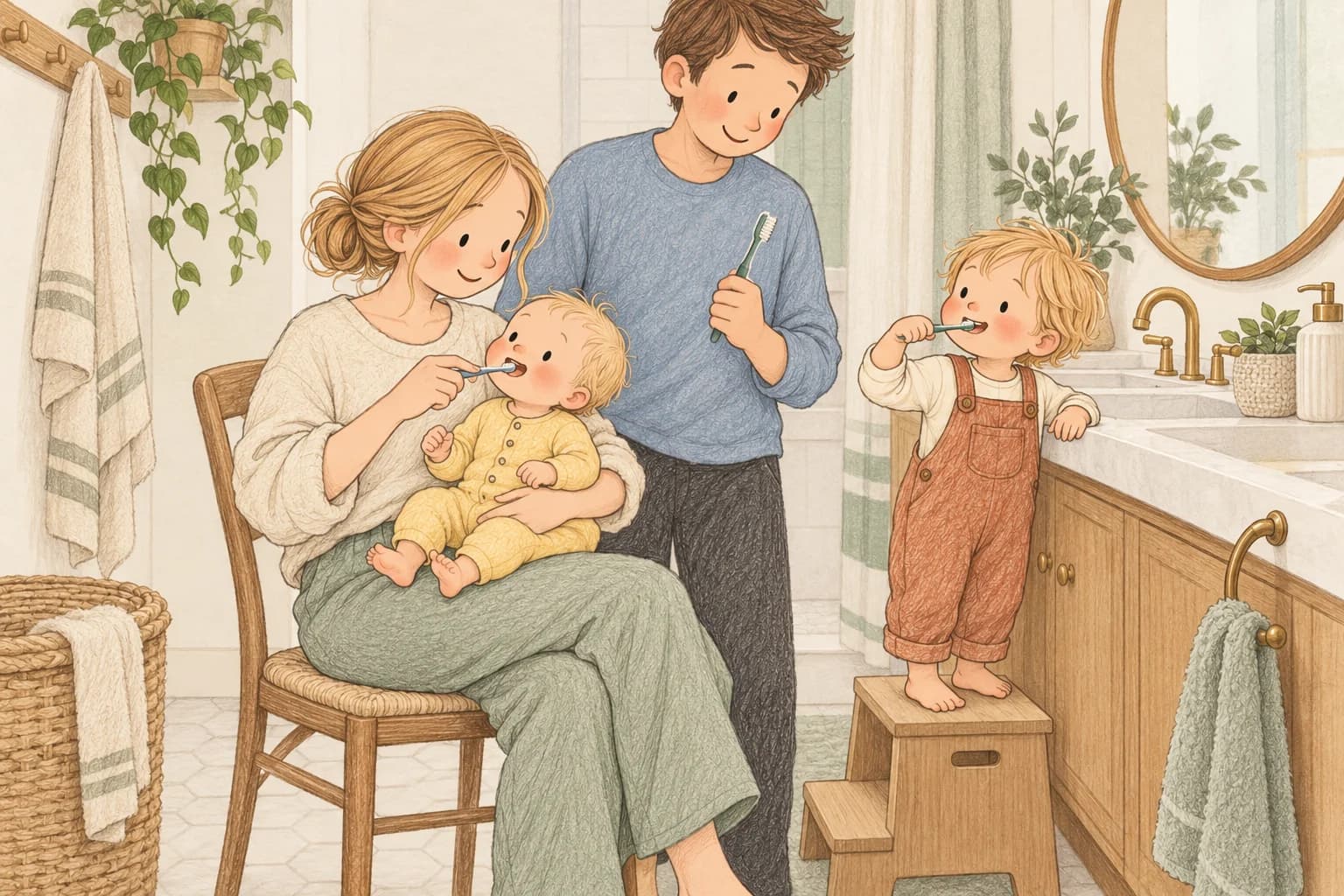
Start brushing as soon as your baby's first tooth appears. Use a small, soft-bristled toothbrush and a tiny smear of fluoride toothpaste, about the size of a grain of rice, twice a day. You do the brushing; a baby does not yet have the skills to clean their own teeth. The American Dental Association's toothbrush guidance supports starting with that first tooth.
You do not need to wait for a full row of teeth, for solid meals to become established, or for your baby to learn to spit. A first tooth is enough to begin a gentle, repeatable routine.
If brushing currently involves a closed mouth, a disappearing toothbrush, and a baby who would rather inspect the tap, you are not the only family figuring this out. The useful goal is consistent adult help, not a picture-perfect bathroom moment.
Choose the toothbrush and toothpaste by function
A baby toothbrush should have a small head and soft bristles so you can reach the tooth surfaces gently. You do not need a complicated kit to start. Pick a brush you can hold and control comfortably, and check that it is intended for your child's age.
For children younger than three, the AAP recommends only a smear of fluoride toothpaste, approximately a grain of rice in size. From age three, the amount changes to pea-sized. Teaching a child to spit comes when they are able; the advice does not say to delay fluoride toothpaste until that skill arrives. AAP: fluoride questions for parents
Check the ingredients rather than relying on a “baby” label. In the UK, the NHS recommends toothpaste containing at least 1,000 ppm fluoride. If you are unsure about the available product, ask your dentist or pharmacist to help you choose one consistent with local guidance and your baby's needs.
Keep toothpaste out of your baby's reach and put the small amount onto the brush yourself. The tube is not a toy or something to suck on. You are controlling both the cleaning and the quantity.
Make brushing physically manageable
Find a stable position where you can support your baby and see their mouth. The NHS baby's-teeth guide suggests sitting them on your knee with their head resting against your chest. This can be easier than trying to balance a baby near the sink while also reaching for supplies.
Brush gently around every surface of the teeth that have come through. A quick touch of the front surface is not the whole job. Use the small brush to reach the sides and, as more teeth arrive, the chewing surfaces too. Your dentist can demonstrate the technique for your baby.
A simple setup might be:
- Put the brush and toothpaste within your reach before picking up your baby.
- Sit securely and support their head and body.
- Apply the tiny smear yourself.
- Gently clean the erupted teeth, checking which surfaces you have reached.
- Rinse the brush afterward and put the toothpaste away.
Those steps are an organizational example, not a reason to push through pain or distress. If brushing seems painful or you cannot find a manageable approach, ask your dental team for help.
Keep the two daily moments easy to remember
The NHS recommends brushing last thing at night and on another occasion during the day. Choose anchors the adults can remember: perhaps after the morning change and near the end of the bedtime routine. The best reminder is one that survives an ordinary busy day.
For bedtime, think about the order of the evening rather than adding a large new ritual. You might offer the usual feed, change your baby, brush their teeth, read a short book, and settle them. Adapt that example to your baby's needs; it is not a prescription for night weaning or a rule against responding to hunger.
If your baby still needs overnight feeds, discuss oral care alongside their feeding needs with the dentist and healthcare professional. Do not remove medically or developmentally needed milk feeds just to fit an internet bedtime sequence.
Share the plan with other caregivers. “Teeth after the evening feed; tiny smear, not a stripe” is more usable than assuming everyone knows what baby toothpaste instructions mean. If bedtime duties alternate, decide who checks that brushing happened rather than leaving it between two adults.
Our shared baby routine guide offers a practical way to hand over everyday care. Brushing does not need an elaborate tracking system; a clear agreement may be enough.
What if your baby resists?
Try making the moment predictable and gentle. Use the same short phrase, let your baby see you brushing your own teeth, or sing a familiar song. The NHS suggests a playful approach and adult modelling when children dislike brushing.
You can offer a small choice without handing over responsibility. For an older baby or toddler, that might be which familiar song comes first. An adult still needs to clean the teeth; chewing on a brush independently does not replace it.
Notice what makes the task difficult. Are you trying when everyone is already exhausted? Is the brush awkward to hold? Are supplies across the room? These are practical problems you can change without deciding that your baby is “bad at brushing.”
If resistance is persistent, ask the dentist to watch your technique and suggest a position or approach. If there is a new sign of pain, bleeding, a damaged tooth, or a visible change that worries you, arrange dental advice instead of assuming it is ordinary teething. NHS: tooth decay and when to see a dentist
Our teething-or-ear-infection guide discusses why new symptoms should not automatically be blamed on teeth. Brushing is routine care; it is not a way to diagnose the reason for a difficult night.
Plan the first dental visit before there is a problem
The American Dental Association recommends a first dental visit after the first tooth appears and no later than the first birthday. This is a chance to check the teeth and gums and get advice tailored to your child, rather than waiting until a tooth hurts.
When you book, tell the practice your baby's age and that this is their first appointment. Ask about forms you can complete beforehand and bring any questions about brushing, toothpaste, feeding, or changes you have noticed.
A short list might include:
| Question | What you want to leave knowing |
|---|---|
| “Can you show me how to position my baby?” | A technique you can repeat at home |
| “Is this toothpaste suitable?” | The appropriate product and amount |
| “How should we approach brushing with our current feeds?” | Advice that fits your baby's actual care |
| “What should prompt an earlier call?” | Clear next steps if something changes |
You do not need your baby to sit still or behave like an older child to attend. Tell the team what usually helps them feel comfortable. If access to a dentist is difficult, ask your local health service about options rather than postponing the question indefinitely.
Look after the brush too
The ADA advises rinsing a toothbrush after use, storing it upright to air-dry, and not sharing it. Replace it when the bristles are worn; its general recommendation is every three to four months, or sooner if bristles are matted or frayed. ADA: toothbrush care
For a nursery visit or overnight stay, pack your baby's own brush and make the care instructions simple. If you use a travel cover, avoid treating a closed, damp container as the brush's everyday storage. Put it somewhere it can dry safely out of the baby's reach.
Common questions
My baby cannot spit. Should I use fluoride-free toothpaste?
AAP guidance still recommends the tiny smear of fluoride toothpaste from the first tooth. Use the correct amount, keep the tube out of reach, and ask your dentist about individual concerns. Teach spitting when your child can manage it; there is no need to rinse afterward.
Is one tooth really worth brushing twice a day?
Yes. The start point is the first tooth, not a particular number of teeth. Beginning now also gives the adults a chance to build the routine gradually.
Can I put honey on a pacifier to settle a teething baby?
No. Do not sweeten a pacifier. Honey is also unsuitable before 12 months because of infant botulism risk; our honey safety guide explains that separate issue.
Will brushing improve sleep?
Brushing supports oral health. It is not a sleep treatment and should not be presented as a way to lengthen naps or prevent night waking. If pain or feeding difficulty is affecting your baby, seek the appropriate assessment.
Sources checked October 22, 2026. General education; not individually reviewed by a clinician. Read our editorial standards or send a correction to team@bambii.app. Cover illustration generated with AI.