


Baby development · 9 min read
Baby Language Development in the First Year: Everyday Ways to Connect
Explore first-year communication milestones, practical talking and reading activities, home languages, and when to seek hearing or developmental support.
Published by the Bambii Editorial Team
The short answer
You can support your baby's early language by talking, singing, sharing books, and responding to their sounds and gestures during everyday care. Pause so they have a turn. You do not need flashcards or a constant stream of activities. If you are concerned about hearing, communication, missed milestones, or a loss of skills, ask for assessment rather than waiting for more home practice to fix it.
Communication starts before clear words. A look toward your voice, a coo, an excited babble, or arms reaching up can all be worth noticing. The National Institute on Deafness and Other Communication Disorders describes development as a progression involving hearing, understanding, sounds, and gestures—not just a first-word count.
This guide focuses on the first year, with ways to make ordinary moments more conversational and a clear approach to bringing concerns to your child's healthcare team.
What counts as language development before words?
It helps to separate a few ideas. Speech involves producing spoken sounds. Language is how people understand and express meaning, including through speech, signs, and other forms of communication. Hearing is also part of the picture for spoken-language development, which is why a hearing assessment may be included when communication is evaluated.
At home, you do not need to classify every sound. Notice what your baby does with another person: do they look, listen, make a sound back, reach, or respond to a familiar routine? These observations can give you a richer description than “not talking yet.”
For example, a baby may lift their arms when a parent approaches, then make a sound as they are picked up. You can respond, “Up you come,” and carry on. There is no need to turn that moment into a test by asking for the same response several more times.
A first-year map, without turning it into a race
Milestones are useful prompts for observation and discussion. They are not promises about the exact day a skill will appear, and they do not replace developmental screening. Use the checklist appropriate to your child's age and discuss prematurity or other medical circumstances with their clinician.
| Stage | Examples to notice | A simple way to respond |
|---|---|---|
| Early months | Responding to familiar voices and beginning to coo | Talk face to face and leave a quiet pause. |
| Around 4–6 months | A growing range of vocal sounds and laughter | Reply to a sound as if it is a conversational turn. |
| By 9 months | Repeated sounds such as babbling strings; lifting arms to be picked up | Add a short word or phrase to the gesture. |
| By 1 year | Waving, a special name for a parent, and responding to “no” | Use familiar words in the situation they describe. |
The early ranges come from NIDCD's communication checklist. The later examples follow the CDC's current nine-month and one-year checklists. CDC milestones describe what most children can do by an age; the materials explicitly are not a diagnostic test.
If one or more milestones are missing, or something worries you, talk with your child's doctor and ask about developmental screening. You do not need to decide whether your concern is “serious enough” before raising it.
Five ways to make ordinary care more conversational
1. Comment on the thing already happening
During a calm nappy change, name one action: “Your sock is off.” During dressing, describe the sleeve or the button. Keep your attention on your baby rather than trying to deliver a lesson.
The NHS guide to helping babies learn to talk recommends talking during everyday care, singing, and responding to sounds. An example in your home might be a familiar phrase when you open the curtains. Repetition can be ordinary; it does not need to be a scheduled exercise.
You can also be quiet. There is no need to narrate every task all day or feel that a silent walk was a missed opportunity. Pick the moments when you and your baby have room for interaction.
2. Leave space for their turn
Say something, then pause. Your baby's turn might be a sound, a look, a smile, or a movement. Respond to what actually happens rather than trying to coax a particular noise.
For example, if your baby makes a soft “ah,” you could echo it once and smile. If they turn away, let the interaction end. The point of this example is to make room for participation, not to get a certain number of exchanges.
For a caregiver who feels awkward talking to a baby, start with one familiar moment: greeting them after a nap or describing a toy they are holding. Ordinary words are enough.
3. Read the picture, not just the sentence
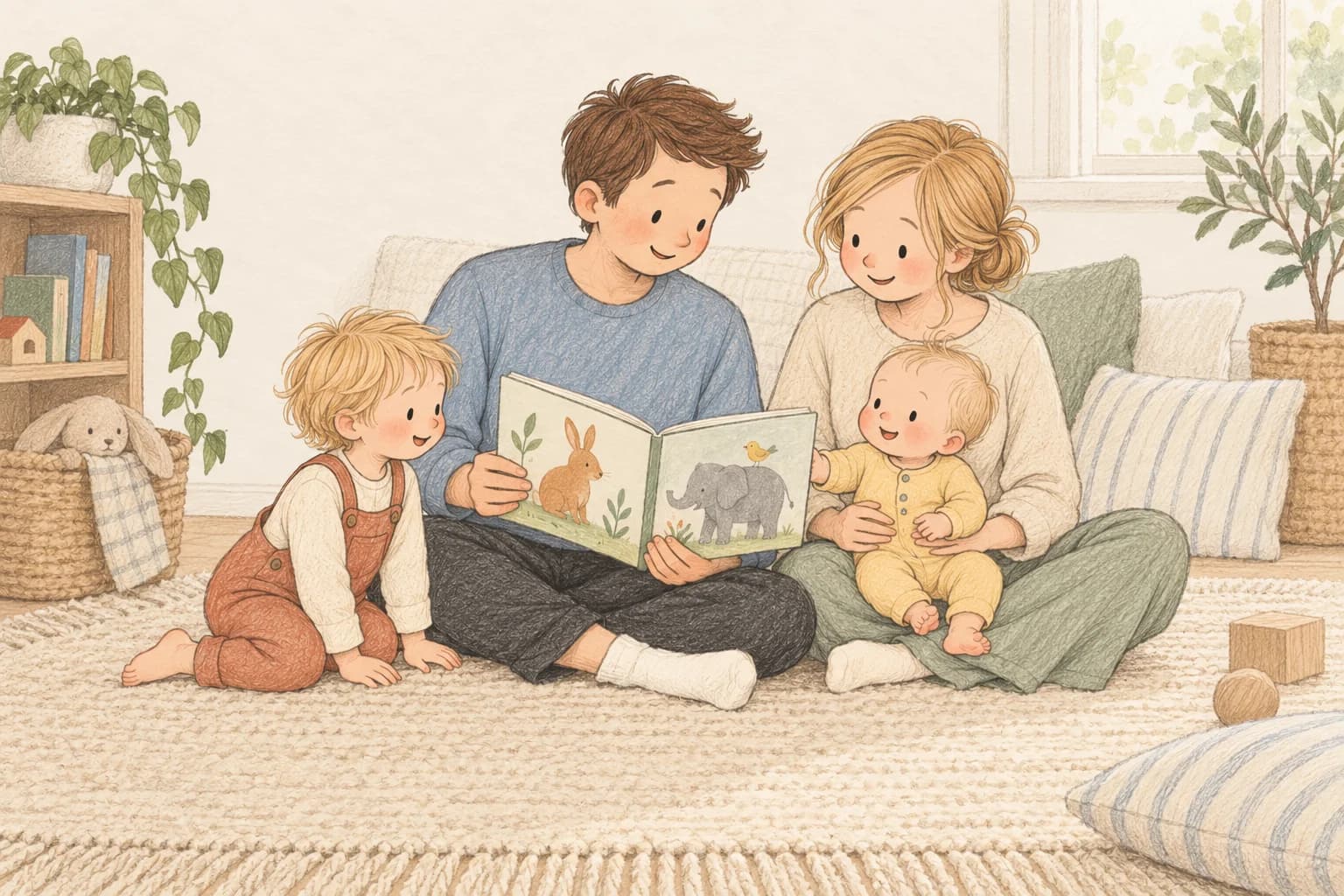
Choose a sturdy, age-appropriate book and sit together with your baby safely supported. You can name one picture, make a gentle animal sound, or talk about what catches their attention. Finishing the book is optional.
Imagine your baby keeps looking at the same drawing while you are ready to turn the page. Stay there a little longer. You might say, “There's the bird,” then wait. That shared attention is the activity; the last page is not the goal.
Keep books in reach for an adult so they are easy to offer during awake time. Put them away from the baby's sleep space afterward. For another kind of quiet play, see our fine motor activities guide.
4. Pair a gesture with a familiar word
A wave at the door or an open hand while asking for a toy can make a conversation visible as well as audible. The CDC includes waving and simple signs among its suggestions for nine-month-olds. Treat them as optional ways to communicate, without promising they will make a child speak earlier.
For example, a caregiver can wave and say goodbye in the language they naturally use. Another caregiver might have a different farewell. You do not need every adult to perform an identical script.
If your child is deaf or hard of hearing, ask the specialist team about accessible language and communication support. A generic baby-sign activity is not a substitute for a full language plan.
5. Follow the baby's interest
If your baby is looking at a cup, name the cup. If they are watching the dog from a safe distance, talk about the dog. A short relevant comment may be easier to share than a question whose answer they cannot yet give.
An older baby might offer you a toy and wait. You could say, “Thank you, you've given me the ring,” then offer it back. That is an example of a shared exchange, not a requirement to teach sharing before your baby is ready.
Use the languages your family knows
Speak in the language or languages that feel comfortable to you. The NHS supports families talking naturally in their home languages. A grandparent does not need to switch to less comfortable English to have meaningful conversations with the baby.
If you seek an assessment, tell the professional which languages your child hears, who uses them, and what communication you notice in each setting. Bring examples from different caregivers rather than judging everything through one person's observations.
You can keep a tiny shared list of familiar gestures or words if it helps: a wave used with one caregiver, a sound paired with a family pet, or a word heard during a routine. The list is a memory aid, not a scorecard or a substitute for assessment.
Leave room for feeding, rest, and real life
Conversation fits around care. If your baby needs milk, comfort, or sleep, respond to that need. You do not have to extend a wake window to fit in a language activity. Our guide to what to do with a newborn while awake offers simple choices for brief alert moments.
A tired parent's contribution can be small: one song while another adult gets a bottle ready, a short greeting, or a page together. There is no daily word quota in this guide. If caregiving feels overwhelming, ask someone to share the practical load rather than adding another developmental task to your list.
When to ask for support
Contact your child's healthcare professional if you have concerns about hearing or communication, your child is missing milestones, or they lose a skill they previously used. Ask about developmental screening and whether a hearing check or speech-language assessment is appropriate. NIDCD explains that hearing can affect speech and language and is often assessed as part of the evaluation.
Bring specific observations: “He used to make these sounds and now doesn't,” or “She doesn't seem to respond to familiar voices.” Mention when you noticed the change and whether other caregivers see it. Avoid repeatedly making loud sounds to test hearing at home.
Common questions
Is babbling the same as a first word?
Babbling and meaningful words are different parts of the picture. Describe what your baby says and the context to your clinician if you are unsure, rather than deciding from one recording.
Can an app tell me whether language is delayed?
A log can help organize observations. It cannot replace hearing assessment, developmental screening, or a qualified clinician's evaluation. A sleep prediction is not a language-development assessment.
Should we wait until the next birthday if we are worried?
No. Raise the concern now. You can keep talking and playing responsively while arranging support; home activities and professional assessment can happen alongside one another.
Sources checked October 15, 2026. General education; not individually reviewed by a clinician. Read our editorial standards or send a correction to team@bambii.app. Cover illustration generated with AI.