


Baby feeding · 8 min read
Introducing an Open Cup: Small Sips, Steady Practice, and the Move From Bottles
Help your baby practise cup drinking with adult support, choose a useful cup, protect needed milk feeds, and plan a gradual move away from bottles.
Published by the Bambii Editorial Team
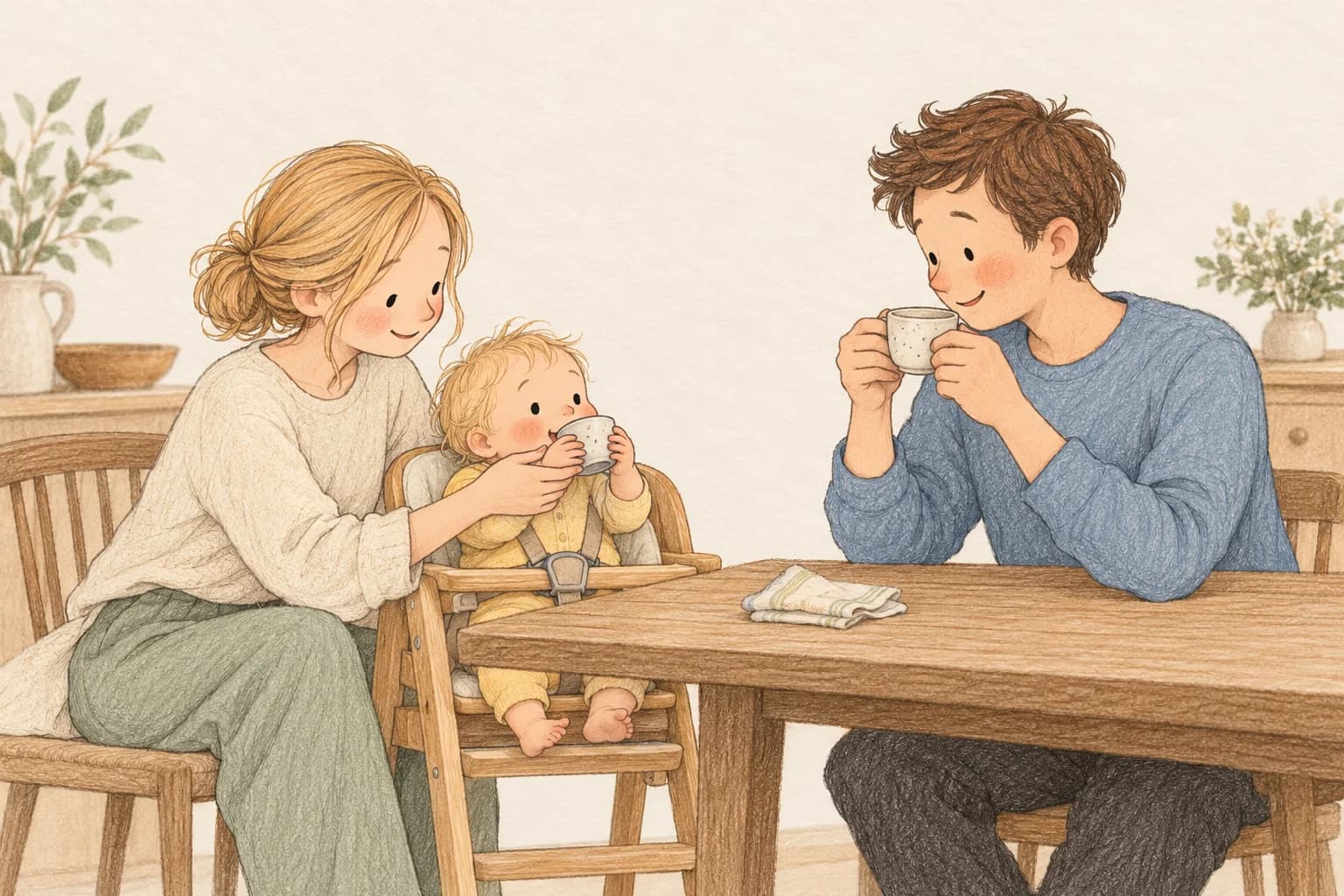
A first cup is a skill to practise
You can introduce cup practice around six months, alongside starting solid foods, with plenty of adult help. The aim is to become familiar with drinking from a cup while keeping your baby's needed milk feeds. It is not a test of whether they can hold a full cup, drink without spilling, or stop breastfeeding.
A baby who reaches eagerly for your mug may still need you to guide every movement of their own cup. Another may watch for a while before trying. You can keep the experience small and ordinary: sit together, offer a little practice, and stop when they have had enough.
This guide focuses on the skill and the gradual move away from bottles. For age-specific advice about water itself, use our separate guide to when babies can drink water.
Why different guides mention different ages
The NHS recommends introducing a cup or beaker around six months, favouring an open cup or a free-flow cup without a valve. The American Academy of Pediatrics also suggests introducing cups around six months.
The CDC's feeding-skills page describes offering a training or straw cup around six months, beginning lidless-cup learning around nine months, and drinking from an open cup held by an adult around twelve months. These descriptions are not identical, and none means a six-month-old should drink independently without spilling.
For a healthy baby beginning complementary feeding, think of an early introduction as an assisted opportunity. Keep helping as needed. If your baby was born prematurely, has difficulty maintaining a supported feeding position, or has a feeding or developmental condition, ask their clinician or feeding therapist how to adapt the plan. A generic age on a webpage cannot settle that question.
Choose for the job you need the cup to do
There is no need to buy a complete progression of specialist cups. The AAP describes a training cup as optional; some children move from breast or bottle to an ordinary cup without that intermediate step.
For practice at the table, you might choose a small, light, unbreakable open cup that you can guide easily. That is a practical starting preference, not evidence that a particular material or brand teaches faster. Pick something intended for food use, with a smooth rim and a shape you can clean thoroughly.
For travel, you may prefer a lidded option. Keep its purpose clear: fewer spills on an outing and open-cup practice at home can both have a place. You do not have to declare one cup “the winner” for every setting.
Useful questions before buying are:
- Can I comfortably help my baby hold and tip this?
- Can I see how much liquid is reaching the rim?
- Does it come apart for cleaning without hidden parts I cannot reach?
- Will every caregiver know how it works?
- Does it fit the needs identified by our feeding professional, if we have one?
A valve-free training cup allows liquid to flow without the bottle-like sucking action of many spill-proof spouts. The NHS and AAP both discuss this distinction. It does not mean every spill-proof cup damages development; avoid turning an equipment preference into a frightening prediction about your child.
Set up one relaxed opportunity
Treat cup practice as part of an ordinary seated meal. Have your baby upright in an appropriate, securely strapped highchair, supervise closely, and keep hot drinks out of reach. The NHS advice for beginning solid foods explains the importance of an upright feeding position and staying with your baby.
Here is an illustrative way to organise the moment, rather than a prescribed therapy exercise:
- Put a small amount of an age-appropriate drink into the cup. You can refill it; a full cup is unnecessary for learning.
- Let your baby see you use your own cup, then offer theirs.
- Help with holding and tipping rather than expecting them to manage both immediately.
- Allow a small sip at their pace. Do not tip liquid into a closed or resisting mouth.
- Pause when your baby turns away, pushes away, or becomes upset. Put the cup down and continue the meal comfortably.
Keep a cloth nearby for spills. If the cup tips over before anyone drinks, that tells you to provide more help next time; it does not establish a developmental problem. Do not repeatedly pour more liquid in to make the session look successful.
For specific questions about cup-feeding technique, particularly when a cup must provide needed milk, get a demonstration from a qualified feeding professional. Casual practice and an individual feeding plan are different situations.
Keep nutrition separate from practice
Breast milk or first infant formula remains the main drink through the first year under NHS guidance. Introducing a cup does not mean replacing needed milk with water, stopping breastfeeding, or switching to cow's milk as the main drink before twelve months.
It helps to ask two separate questions: “Did we offer a comfortable chance to practise?” and “Is my baby getting the nutrition they need?” A few spilled sips can answer the first question without answering the second.
For example, a baby might explore the cup during lunch and continue their usual milk feeds. An older infant moving more milk feeds into a cup may need a different plan, especially if intake drops. Do not treat the amount missing from the cup as an accurate measure of what was swallowed; some may be on the bib or tray.
If you are also starting complementary foods, our starting-solids guide covers that wider transition. If your baby is refusing bottles and you need another way to provide milk now, read the bottle-refusal guide and arrange feeding support rather than relying on a few practice sips.
Plan a gradual move away from bottles
The AAP recommends completing the bottle-to-cup transition between twelve and eighteen months. The NHS advises discouraging bottles after the first birthday. These are opportunities to plan ahead with your child's clinician, not a reason to abruptly remove a feeding method when your child cannot yet take adequate nutrition another way.
You can make the family plan concrete without writing a rigid timetable. Choose which daytime opportunity will be easiest to practise consistently. Agree who will offer it, which cup you will use, and how you will respond if your child declines. As cup use becomes established, discuss how remaining bottle feeds will change.
For a child with an individual medical or developmental feeding plan, follow that plan. The AAP specifically recommends professional guidance when a condition affects the transition.
Comfort can remain even when the container changes. You can still sit close, talk, and share the familiar parts of the routine. There is no requirement to withdraw cuddles as well as a bottle. Keeping caregivers informed is often more useful than presenting the change as a contest of wills.
What to notice, and what needs help
A simple observation is enough: “Needed both hands guided,” “Took a sip then stopped,” or “Pushed the cup away.” These notes may help another caregiver offer similar support. They are not scores to compare with a baby on social media.
Repeated coughing with drinking, a wet or gurgly voice afterwards, breathing difficulty during feeds, persistent distress, or concerns about growth need professional assessment. ASHA describes these as possible feeding or swallowing warning signs. Do not keep increasing the amount or changing the liquid's thickness to push through a problem.
Seek urgent medical advice if reduced drinking is accompanied by fewer wet nappies or unusual drowsiness. The NHS dehydration guide explains when these signs require urgent care. Get emergency help for difficulty breathing, blue or grey colour, or difficulty waking.
Questions parents often ask
Does my baby have to master a straw first?
No single cup sequence is compulsory for every child. The AAP describes several options and notes that a training cup can be skipped. Choose an approach that fits your baby and any professional advice they have received.
Does moving to a cup mean weaning from breastfeeding?
No. A cup is another drinking skill. Breastfeeding can continue, and you do not need to introduce bottles just to prepare for cups.
Is it a problem if most of the drink spills?
Spills are expected during learning. Keep supporting the cup and protect needed milk intake. If drinking is persistently difficult, distressing, or accompanied by the warning signs above, ask for an assessment rather than assuming every problem is ordinary practice.
What if another caregiver uses a different cup?
Share what your baby can currently manage and what help they need. An example note is “Please hold and guide the cup with them; they are not drinking independently yet.” That is more useful than simply writing “uses a cup” on a handover form.
Sources checked October 29, 2026. General education; not individually reviewed by a clinician. Read our editorial standards or send a correction to team@bambii.app. Cover illustration generated with AI.