


Baby care · 7 min read
How to Trim Baby Nails: A Calm, Practical Guide
Prepare for baby nail care with suitable tools, good lighting, a supported hand, and practical advice for sharp edges or small accidental nicks.
Published by the Bambii Editorial Team
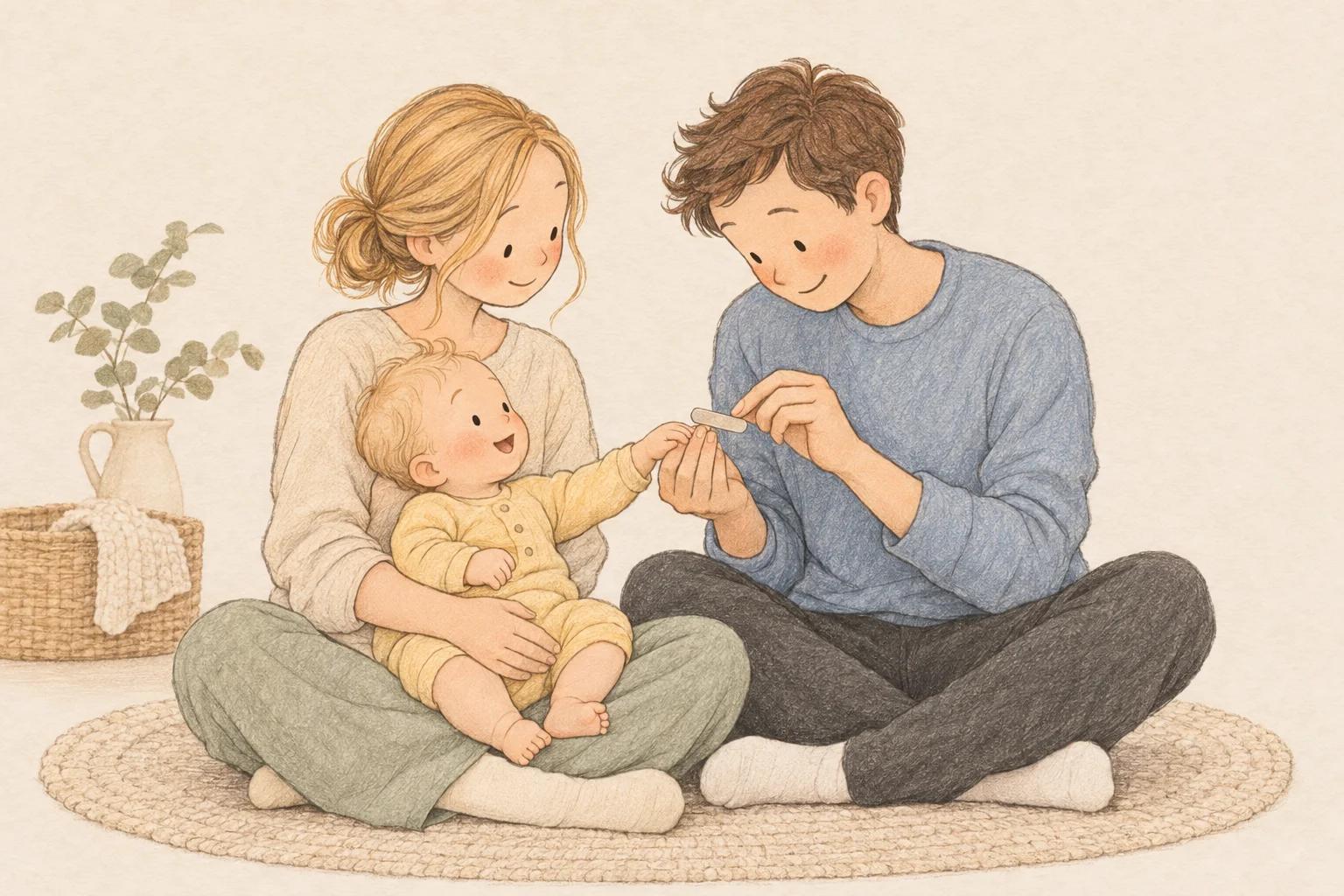
The short answer
Use a soft baby nail file, baby clippers, or suitable baby nail scissors, with good lighting and your baby's hand supported. Work when they are calm, gently move the fingertip pad away from the nail, and stop if you cannot clearly see what you are trimming. You can do one or two nails and leave the rest for another calm moment. The AAP's nail-care guide explains the basic technique.
A tiny hand can make an ordinary nail clipper suddenly feel enormous. It is reasonable to be nervous. A slower setup, a softer tool, or another adult helping can make the task feel less daunting. There is no prize for finishing both hands in one sitting.
When do baby nails need trimming?
Look at the nails themselves rather than following a strict calendar. If the edges are sharp or catching, they may need smoothing. Newborn nails can be very soft; some wear down through everyday contact, while others quickly become scratchy. Raising Children Network recommends trimming or filing as needed.
A quick look during an ordinary change can be enough to remind you. You do not need to add an alarm or a daily grooming target. Check toes too, but do not assume they grow at the same rate as fingernails.
If you cannot distinguish the nail's free edge from the skin beneath it, ask your midwife, nurse, or paediatrician to demonstrate. Waiting for a clearer, calmer opportunity is better than guessing where to cut.
Our baby-bathing guide can help you organise the surrounding care routine. Nail care does not have to happen in the bath or immediately afterwards.
Choose a tool you can control
A soft emery board can smooth a sharp edge without a cutting blade. Baby clippers and baby nail scissors are other options. The American Academy of Dermatology advises using a file to leave smooth edges and ensuring plenty of light.
You do not need an expensive grooming kit. What matters is being able to hold the tool steadily, see the edge, and use it as intended. If you choose an electric baby file, read its age and attachment instructions; this article does not establish that powered files are safer than ordinary files.
Set out only what you will use. Keep tools out of your baby's reach before and after the task. A small tray on an adult-only shelf can be more practical than searching through a large basket while holding a moving hand.
For a first attempt, you might simply smooth one rough corner with a soft file. That is a complete useful task. It does not have to become a full manicure.
A calm setup before you start
Choose a position where the baby is securely supported and you can see their hand without leaning awkwardly. Another adult can hold and reassure the baby while you focus on the nail. Ireland's HSE specifically suggests asking someone to help hold the baby's hand if needed.
Before picking up the tool, check:
- Is the light bright enough to separate the nail edge from skin?
- Is your baby's body supported, including their head and neck as needed?
- Can you reach the supplies without leaving them?
- Is the baby calm enough for you to hold one finger gently?
- Are you able to stop immediately if the hand moves?
These are practical preparation questions, not a test your baby has to pass. If feeding, a change, or comfort is needed first, do that. You can return to the nails later.
Avoid making the task part of a hurried exit from the house. “We have time to do one thumb” is a more useful starting point than “We must finish before the taxi comes.”
How to trim or file the nail
Hold the finger steadily without squeezing. Gently move the fingertip pad away from the nail so you can see the separation, then trim the visible free edge or smooth it with the file. Finish by checking for a sharp corner. This follows the AAP's practical trimming advice.
For toenails, cut straight across rather than digging into the sides. Raising Children Network gives this advice to help avoid ingrown nails.
If your baby pulls their hand away, stop the cutting motion. Reposition only when you can see clearly again. The next nail can wait.
Here is a fictional family example: Dad holds the baby securely while Mum files two scratchy nails. The baby becomes restless, so they put the file away. At the next calm opportunity, they check the remaining nails. Nothing about this requires a set number of minutes or a daily completion target.
Is it okay to do nails while my baby sleeps?
The AAP and HSE both describe sleep as a possible opportunity because hands may be still. It is an option, not a requirement. A calm awake baby can be easier for some families.
Do not create an unsafe sleep setup to make nail trimming more convenient. Keep pillows, loose blankets, and grooming supplies out of the sleep space. If your baby wakes or moves, pause. You do not have to preserve sleep at the expense of seeing what you are doing.
For the actual sleep arrangement, follow NIH Safe to Sleep advice. The nail task does not change the need for a firm, flat, clear surface or back sleeping.
If you are exhausted and struggling to focus, leave the grooming for another opportunity or ask someone else to help. Nail care can fit around your family's routine; it does not need to determine the routine.
What if I accidentally nick the skin?
Put down the tool and apply gentle pressure with clean gauze or a clean cloth until the bleeding stops. This is the HSE's advice for a small accidental cut.
Do not put an adhesive plaster or bandage on a baby's finger where it could come off in their mouth. Raising Children Network warns that this can be a choking risk. If bleeding does not stop, the wound looks more than minor, or you are concerned, get medical advice promptly.
An accidental nick does not mean you are incapable of caring for your baby. Once the immediate care is handled, consider what would help next time: stronger light, a file, a different time, or someone demonstrating the technique.
Avoid biting, peeling, and cutting too close
The AAP warns that biting nails can lead to infection. Use a suitable tool rather than trying to tear away a loose edge.
You may encounter conflicting advice about peeling very soft newborn nails. This guide recommends a soft file or appropriate trimming rather than pulling at the nail or nearby skin.
Do not cut into the skin or chase a deeply attached corner. If the skin around a nail becomes swollen, painful, red or otherwise discoloured, ask a clinician to assess it. The AAP's finger-and-toe care guidance explains that inflammation around a nail needs attention.
Questions parents ask
Can I just keep mittens on all day?
Covered hands are not a long-term substitute for nail care. Babies also use their hands to explore. Sydney Children's Hospitals Network advises against keeping hands covered for too long.
What if my baby will not stay still?
Stop and try another calm opportunity, use a soft file if appropriate, or ask another adult to help. If every attempt feels unmanageable, request a demonstration at a routine healthcare visit.
Do I need to log nail trimming?
Usually no. A simple handover can be enough: “Both thumbs are smooth; the other nails still need checking.” Bambii's broader caregiver routine guide is about sharing useful information, not recording every small care task.
Sources checked November 12–13, 2026. General education; not individually reviewed by a clinician. Read our editorial standards or send a correction to team@bambii.app. Cover illustration generated with AI.